

How to Control Company Spending Without Slowing Growth
Most organizations don’t lose control of spending because they lack policies, budgets, or approval rules. In most cases, those things already exist. Control slips because spending decisions happen faster than oversight can meaningfully influence them.
As teams grow and work becomes more distributed, purchasing decisions are made earlier, more often, and across more functions. By the time finance reviews the impact, the money is usually already committed. That delay forces leaders into a tradeoff they shouldn’t have to make: move quickly or stay in control.
Modern spend management isn’t about choosing one over the other. It’s about redesigning how decisions move through the organization so speed and discipline reinforce each other instead of competing.
This article looks at where spend control actually breaks down and how organizations can redesign decision flow so control happens naturally, without slowing everyday work.
Replace blunt cost-cutting with decision control
When financial pressure rises, many organizations reach for blunt controls: hiring freezes, blanket budget cuts, and delayed investments. These actions may reduce spend in the short term, but they also disrupt how work gets done. Critical purchases slow down, approvals pile up, and teams lose momentum at the exact moment the business needs to stay responsive. Finance, meanwhile, is pulled into exception handling rather than guiding decisions.
The issue isn’t that organizations are trying to control spend. It’s how they’re doing it.
Cost-cutting operates after the fact. It restricts activity broadly, without distinguishing between decisions that matter and those that don’t. Decision control works earlier. It focuses on shaping spending choices before commitments are made, so tradeoffs are considered in context rather than corrected later.
This shift changes the role of approvals. Instead of serving as enforcement gates, approval workflows become decision checkpoints—places where intent, priority, and impact are weighed while options remain open. The goal is not to slow the organization down, but to ensure that speed doesn’t come at the expense of clarity.
When decisions are evaluated with the right context upfront, fewer corrections are needed downstream. Control improves not because activity is constrained, but because choices are made deliberately, with an understanding of their consequences.
Align spend data before decisions are locked in
Controlling company spending depends less on individual approvals and more on whether decision-makers can see how each request fits into the broader financial picture at the moment it’s evaluated.
When spend data is fragmented, decisions are assessed in isolation. A request may seem reasonable on its own, a purchase order may follow the right steps, and an invoice may match what was approved, yet no one has visibility into how those actions collectively affect available budget, existing commitments, or near-term priorities. Over time, this lack of shared context allows spend to drift without any single decision appearing wrong.
Aligning spend data addresses that problem by creating continuity between intent, commitment, and payment. When current requests, approved spend, pending commitments, and historical patterns are visible together, decision-makers can understand the downstream impact of a choice before it’s finalized, rather than discovering consequences after options have narrowed.
Spend insights and analysis make proactive spend control possible. Finance no longer has to slow the business or insert itself into every decision, because control comes from having the right context at the right moment. Spending stays aligned not through constant intervention, but because decisions are made with an accurate understanding of what they will displace, delay, or require.
Standardize requests before approvals begin
Email-based intake, ad hoc forms, and spreadsheet tracking mean purchase requests often enter the organization inconsistently. Critical information is missing. Approvals happen out of sequence. Context is lost as work moves between tools and teams. By the time issues surface, commitments are already made, and finance is left resolving problems that originated much earlier.
Control improves when variability is reduced before evaluation begins, at the point where requests are created. A structured intake-to-order process ensures that every request captures the same core context upfront: what’s being purchased, why it’s needed, who owns the budget, and how it fits within existing commitments. Approvals begin with clarity instead of reconstruction.
This doesn’t slow teams down. It removes rework. When requests enter the system in a consistent, governed manner, approvals move faster, non-POs occur less frequently, and finance spends less time untangling downstream issues. Control improves not because more rules are enforced, but because fewer decisions require correction later.
Intervene selectively instead of reviewing everything
When spending decisions are structured correctly, finance no longer needs to review everything to stay in control. The work shifts from monitoring individual transactions to paying attention to patterns that signal risk, drift, or changing priorities.
Instead of inserting itself into every approval, finance focuses on where behavior deviates from expectations. That might be sustained increases in vendor costs, repeated exceptions in a specific category, or approval cycles that start to stretch. These signals matter not because they violate policy, but because they indicate that the underlying decision environment is changing.
This approach allows finance to intervene earlier and more precisely. Guardrails can be adjusted, thresholds revisited, or priorities clarified without slowing routine work. Teams continue operating without friction, while finance maintains confidence that emerging issues won’t compound unnoticed.
Oversight becomes intentional rather than exhaustive. Control improves because attention is applied where it has leverage, not because every decision is manually reviewed.
How mid-Market organizations regain control of spending
Mid-market organizations regain control of spending by changing how decisions are made, not by adding more reviews after decisions are already set. When intent, budget context, and constraints are visible at the moment a decision is approved, spending stays aligned without requiring constant intervention.
In this model, finance spends less time reconstructing what happened and more time setting priorities and planning ahead. Procurement contributes earlier by coordinating timing, context, and supplier options, rather than stepping in late to block or unwind decisions. Teams move faster because expectations are clear and consistent across the organization, so fewer decisions need to be revisited.
The result is predictable spending instead of rigid control. Leaders approve spend with a clear understanding of its impact on budgets and priorities, and tradeoffs are visible before commitments are made. Over time, this approach delivers the broader benefits of spend management without relying on manual reviews for every decision.
This is what durable spend control looks like in practice. It becomes part of how the organization operates day-to-day, supporting faster execution while maintaining clarity and control as the business scales.
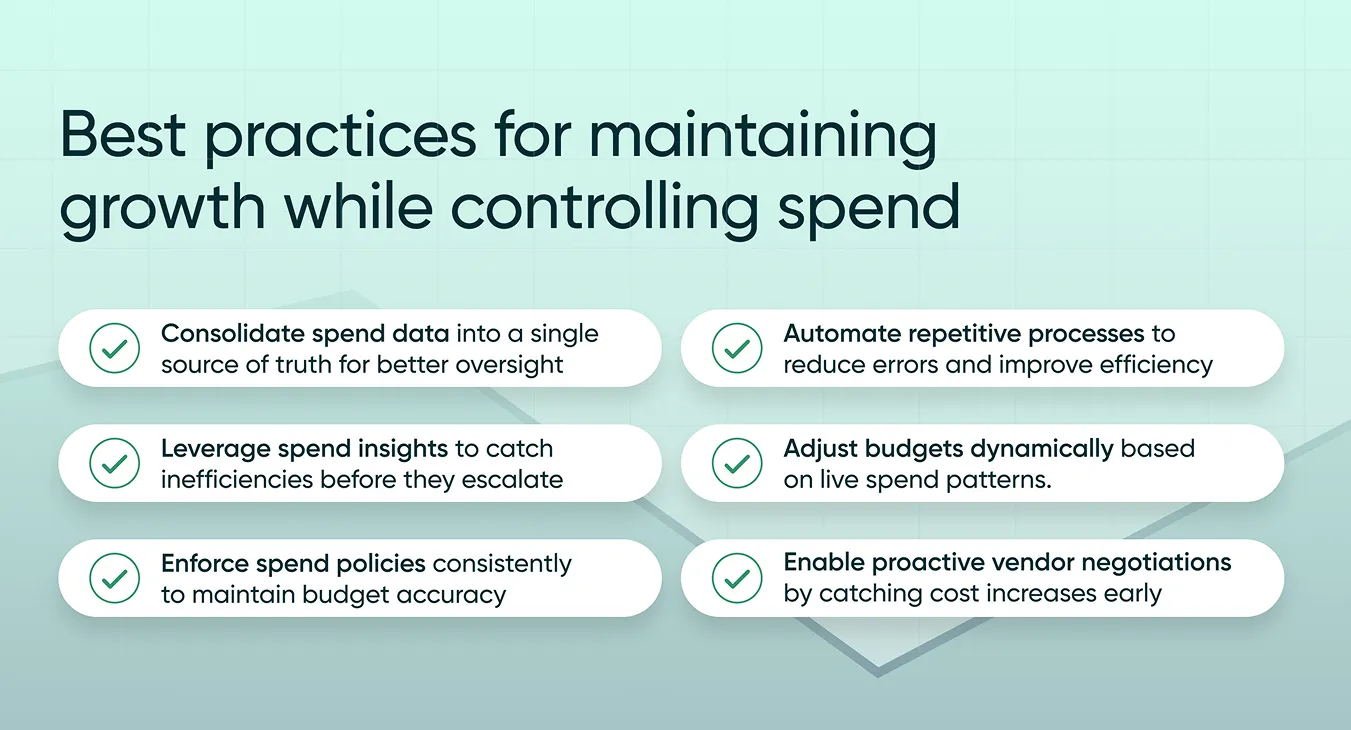
Best practices to control spend
By adopting these practices, companies can scale confidently without financial friction.
For teams comparing approaches, our Spend Management Software Buyer’s Guide outlines the capabilities modern spend management software needs to support decision-making control at scale.

Preview AI Intake for Orders
Take the product tour to see how the new intake experience works.