


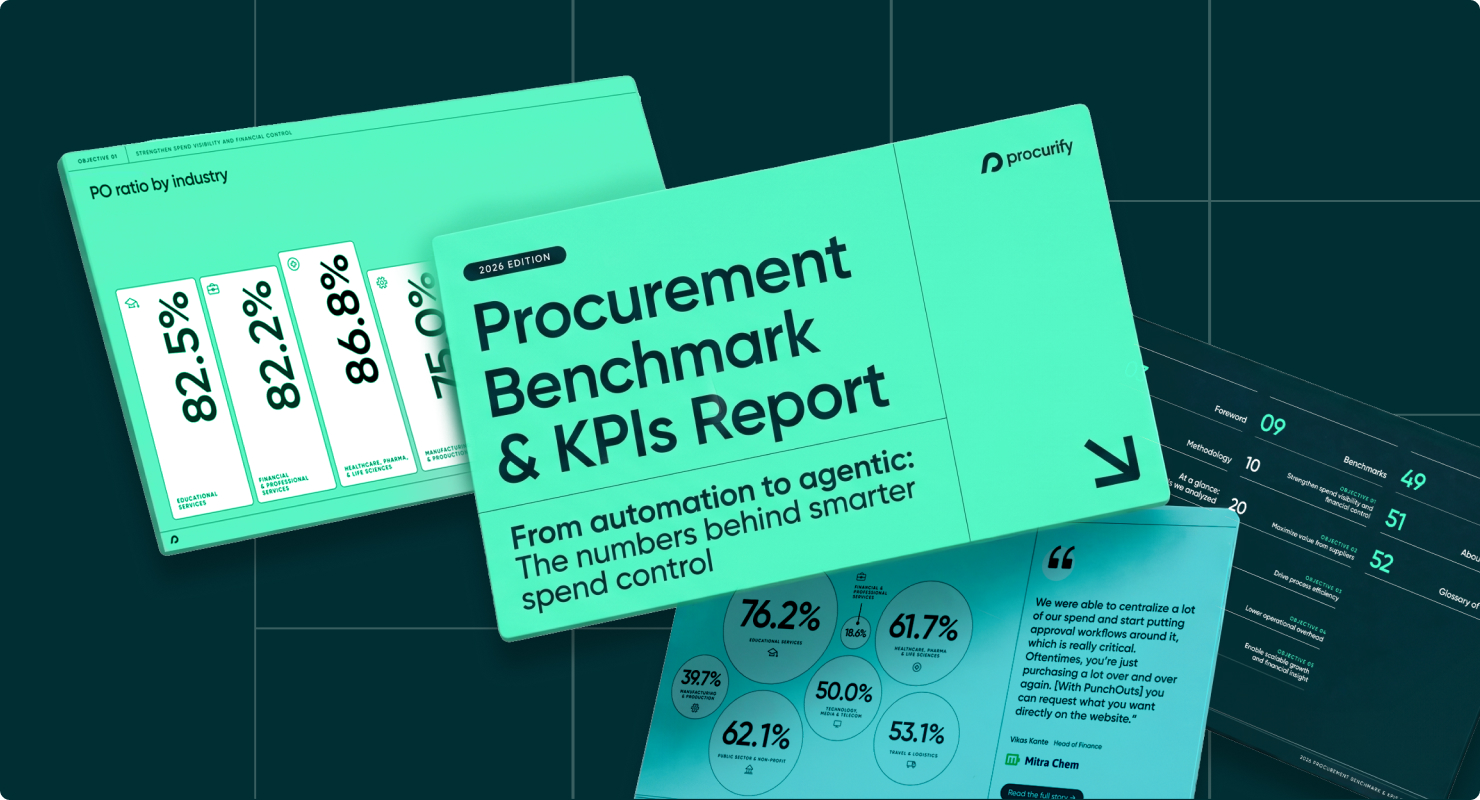
2026 Procurement Benchmarks: Key KPIs for Smarter Spend Control Data Across 7 Industries
Most finance leaders already have access to procurement data — dashboards, approval logs, invoice queues, and cycle time reports.
What’s harder is putting those numbers in context. Procurement data is often spread across systems, tied to specific workflows, and reported in isolation. Without a consistent way to compare performance over time or against similar organizations, it’s difficult to tell whether a metric reflects strong performance, normal variation, or something that needs attention.
This article draws on Procurify’s 2026 Procurement Benchmark Report, which is based on over $30 billion in anonymized customer spend data across seven industries and three years. It focuses on the 12 procurement KPIs that matter most, where organizations currently stand, and what the data suggests about how procurement is evolving.
What is procurement benchmarking and why does it matter?
Procurement benchmarking is the practice of comparing your organization’s procurement performance against relevant peer data to understand where you stand and where to focus improvement.
In practice, it’s most useful when applied at the KPI level. Rather than asking whether procurement performance is “good” overall, benchmarking procurement KPIs helps answer more specific questions: which parts of the process are working as expected, which are lagging behind peers, and how large those gaps are.
That level of detail changes how teams prioritize. A cycle time that looks acceptable on its own may not be the constraint that matters most. A relatively small gap in supplier concentration or tail spend may represent a larger opportunity to improve cost control or reduce operational effort.
This is especially meaningful now because procurement has more levers to act on than it did a few years ago. Teams can redesign intake, automate approvals, route more spend through PunchOut catalogs, consolidate suppliers, and reduce non-PO spend with more precision. Benchmarking helps identify which lever is most likely to have the greatest impact.
PO coverage rate in procurement: A benchmark for spend control
PO coverage rate, the percentage of organizational spend that flows through a formal purchase order, is one of the most widely tracked procurement performance metrics in mid-market organizations. In 2025, PO coverage across the seven industries in Procurify’s dataset averaged 76.9%, up from 71.8% in 2023. While many organizations cluster around this range, there is notable variation by industry and company size.
Spend that bypasses a purchase order also bypasses the controls, visibility, and accountability that a structured purchase order process is designed to provide. Non-PO spend often surfaces later, through invoices that require coding, clarification, or retroactive approval. The result is not just audit risk, but a growing gap between what finance expects to see and what is actually happening in real time.
The industry variation in the report shows how differently this maturity plays out. Healthcare, Pharma, & Life Sciences lead the dataset at 86.8%, while other industries sit closer to the low-to-mid 70s. That spread likely reflects differences in how consistently purchasing workflows are structured and enforced across organizations, rather than a single factor like industry complexity.
The broader takeaway is that PO coverage improves when structured purchasing becomes the default, not the exception. The full dataset shows which industries are pulling ahead and where the largest gaps still exist.
Curious how your organization compares across all 12 KPIs? Download the full benchmark report now.
Tail spend benchmark: Measuring informal purchasing
Tail spend measures the share of low-dollar, high-frequency purchases that fall outside formal procurement channels. In 2025, it ranged from 8.9% in Technology, Media and Telecom to 26.5% in Public Sector and Non-Profit organizations, highlighting how differently industries manage informal purchasing.
Many organizations struggle to calculate this metric at all. It requires transaction-level visibility across all spend, including purchases that never went through a formal workflow. In practice, the organizations with the highest tail spend are often the least equipped to measure it, particularly where informal or “maverick” purchasing is still common.
The industry spread reflects more than operating differences. It shows how consistently low-dollar purchasing is structured. Reduced tail spend demonstrates that meaningful improvement is possible when repeat purchases are routed through standardized, self-serve workflows.
For organizations still in the mid-20% range, tail spend is less a one-off issue and more a structural pattern. The opportunity is not just to measure it, but to reduce reliance on informal purchasing by making approved buying paths easier to use.
Requisition-to-PO cycle time: Scaling procurement workflows
Requisition-to-PO cycle time measures the hours between a purchase request submission and an approved purchase order. In 2025, the median was 55 hours, up from 51 hours in 2024 and down from 59 hours in 2023.
The initial improvement reflects what happens when organizations move from manual, email-based approvals to structured workflows. Requests are routed consistently, approvals follow defined paths, and the process becomes visible, a shift clearly reflected in the report data.
The increase in 2025 points to a different dynamic. As purchasing volume grows and organizations become more complex, approval workflows often span more stakeholders, more exceptions, and greater variation across departments. The processes that delivered faster cycle times initially are not always designed to scale without adjustment.
This pattern shows up across the dataset. Gains from digitization are real, but they tend to plateau without ongoing process refinement. Improvements in cycle time increasingly depend on how workflows are designed and maintained, not just whether they are automated.
The next step is more targeted: identifying where delays occur by transaction type, department, or approval chain and simplifying those paths rather than applying a single workflow more broadly.
A similar pattern appears in AP processing time, where delays are often concentrated in specific stages of the process rather than distributed evenly.
What good procurement actually looks like
Across these metrics, a consistent pattern emerges: procurement maturity is no longer about whether a process exists. It is about whether that process produces the visibility, control, and clean data needed to support better decisions.
The strongest teams are not simply digitizing existing processes. They are making purchasing easier to control, easier to follow, and easier to scale.
The next phase of intelligent procurement will not be defined by digitization alone. Most organizations have already done that work. The advantage now comes from how effectively that foundation is used to build what’s next and how quickly teams can act on the data.
Today’s benchmarks aren’t just a snapshot of performance. They show how ready organizations are for what comes next.
Download the 2026 Procurement Benchmark & KPIs Report to see how your performance compares across 12 KPIs and where the biggest gaps and opportunities exist in your industry.
$30B+ in real spend data you won’t get anywhere else
Find out what it takes to move from reactive to AI-driven operations.


