2026 AI Readiness in Finance Report
We surveyed 300+ procurement, finance, AP, IT and Ops pros to get their take on AI adoption, urgent opportunities, and operational impact across the mid-market.
Find out what your mid-market finance and procurement peers think about AI adoption, trust barriers, and early ROI

The 2026 AI Readiness in Finance Report summarizes survey data on how mid-market organizations are using AI across finance and procurement workflows, where there are limits to broader rollout and ways to turn early wins into sustained deployment.
The results show widespread usage and growing embedded adoption. At the same time, the leading constraints on scaling AI are security and compliance concerns, integration complexity, and trust in AI outputs.
This report covers four areas:
- AI adoption levels in finance and procurement
- Governance, risk, and security barriers
- Where AI is trusted versus where human oversight remains required
- Early operational ROI, including time savings, accuracy, and spend visibility
Key findings on AI in finance at a glance
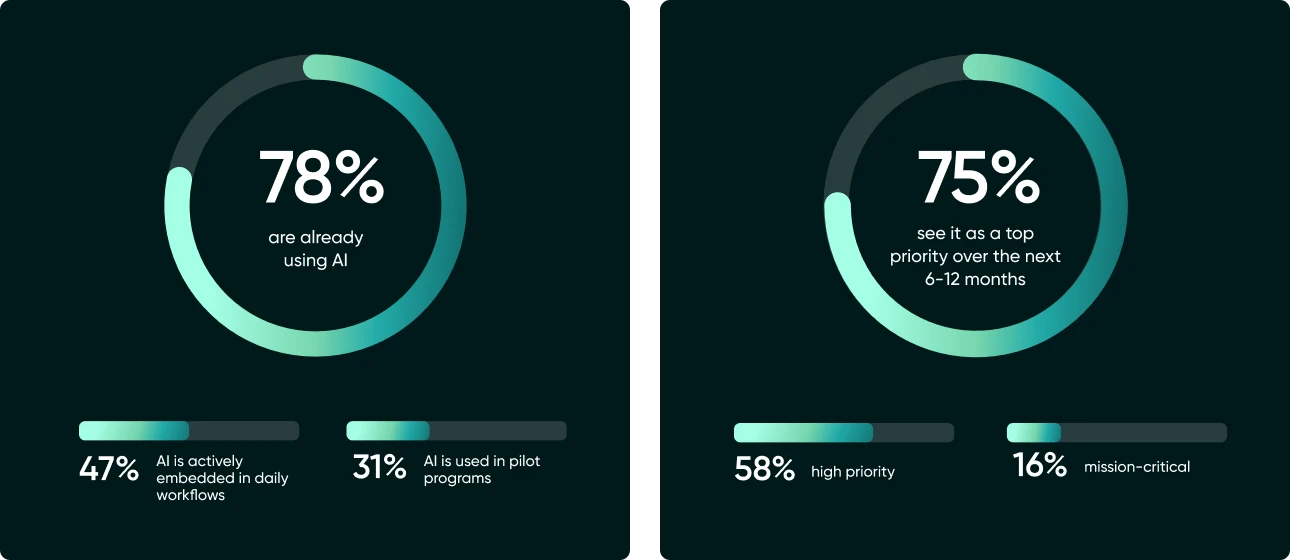
78%
report active AI usage in finance and procurement workflows
47%
say AI is embedded in daily workflows
75%
rank AI as high priority or mission-critical in the next 6–12 months
35%
cite trust in the AI model as the top barrier to broader adoption
63%
report time savings and faster workflows from AI
5%
report no significant impact so far
“The practical ROI highlighted in Procurify’s study parallels Hackett’s recent research in which procurement leaders report tangible gains in productivity and cycle‑time reduction as AI is applied to routine sourcing, analytics and transactional activities.”
Elizabeth Zucker
Associate Principal, Procurement Advisory Practice, The Hackett Group
AI adoption in finance has crossed the majority threshold
A clear majority of respondents report using AI in finance-related workflows, and 47% say AI is embedded in daily operations, meaning repeatable use inside routine workflows rather than isolated experiments.
Adoption is also a near-term priority. 75% of respondents rank AI as high priority or mission-critical to procurement strategy in the next 6–12 months.
At this stage, the constraint shifts from adoption to consistency. As embedded AI workflows expand, workflow maturity becomes more consequential. Organizations operating within a defined procurement process are better positioned to scale repeatable AI use because inputs, approvals, and documentation are more standardized.
This is where the data points next: AI usage is common, but embedded usage increases the importance of structured workflows and clear control points.
AI readiness in finance is defined by trust, risk, and integration complexity
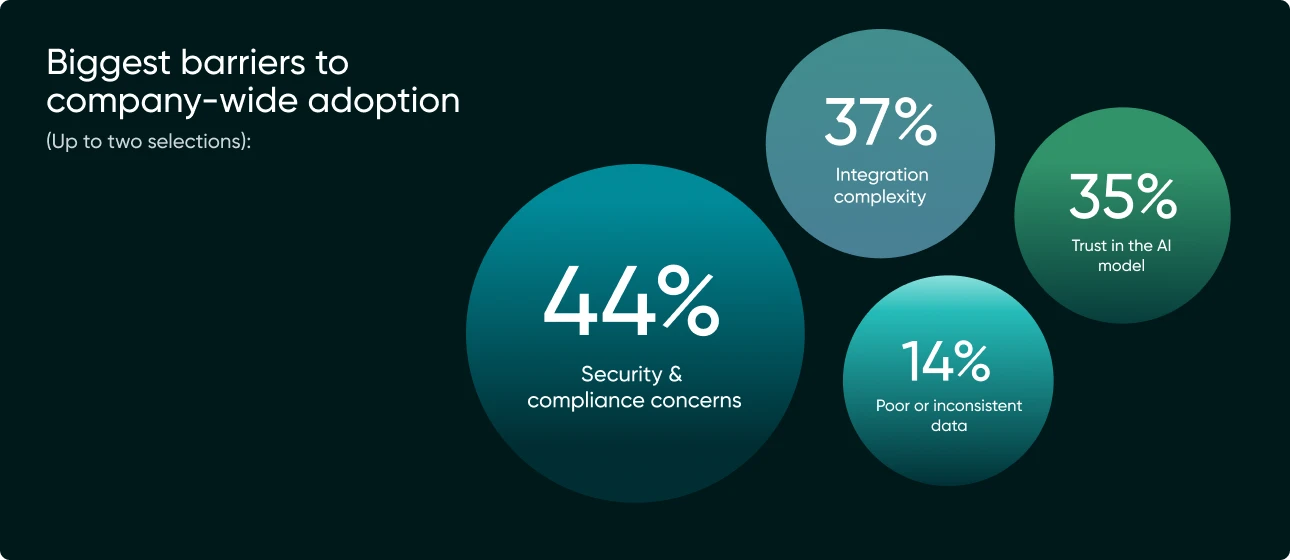
Poor data quality might be the assumed primary obstacle to scaling AI in finance but it actually ranks the lowest among the top barriers. When asked what limits broader AI rollout, respondents cited:
- 44% Security and compliance concerns
- 37% Integration complexity
- 35% Trust in model outputs
- 14% Poor or inconsistent data
Security and compliance concerns rank highest, a pattern consistently reflected in extensive AI research.
“Lack of trust being a significant challenge to AI readiness strongly aligns to recent Hackett research. While data and technology foundations are largely in place, organizations feel under-prepared in areas of governance, data integrity, and longer-term strategies for deploying AI.”
Elizabeth Zucker
Associate Principal, Procurement Advisory Practice, The Hackett Group
The results suggest a shift in what “readiness” means. Broader adoption is less constrained by data access and more constrained by whether teams can rely on outputs within financial controls.
There’s a clear need for outputs that are accurate, explainable, and safe to act on. This aligns with the focus of procurement intelligence, which centers on traceable insights and structured decision support.
The report also revealed that higher-quality, real-time spend data would most accelerate effective AI use, signalling a preference for timely, consistent information that supports day-to-day decision-making.
Where finance teams trust AI and where they don’t
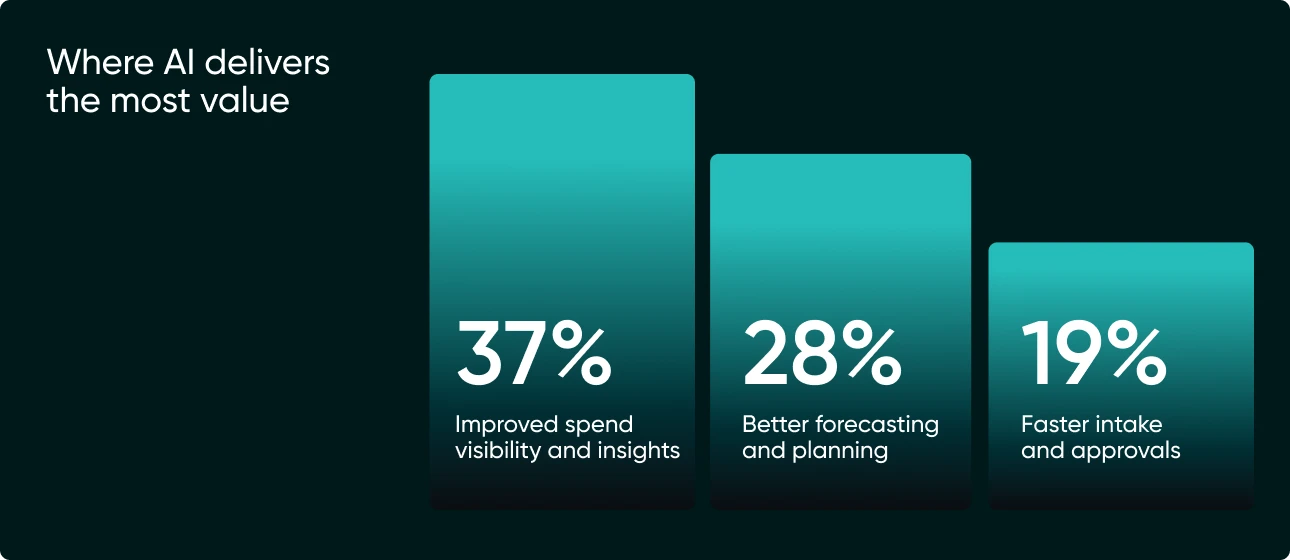
There are clear areas where respondents say AI delivers the most value:
- Spend visibility and insights
- Forecasting and planning
- Faster intake and approvals
These are analytical and preparatory uses. They support earlier insight and faster workflow movement, rather than replacing final decision authority.
When asked where AI adds the least value, 43% selected final approvals and accountability decisions. Most want to review information before acting on AI-generated insights, and only a minority feel comfortable acting without oversight.
The boundary is consistent in the results: AI is used to inform decisions, while final authorization remains human-led in areas tied to financial control and risk.
Notably, only 4.5% of respondents said executive sponsorship improved AI preparedness, ranking low compared to operational and governance-related factors.
Early AI ROI in finance is practical and measurable
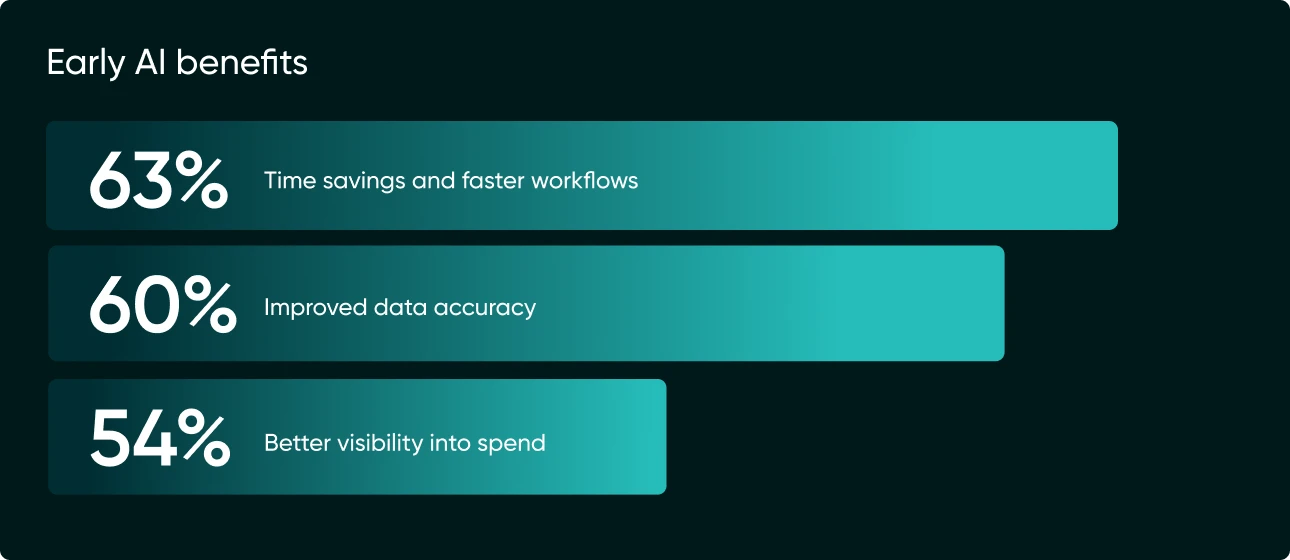
Despite concerns around governance and risk, there’s already measurable operational impact from AI:
- 63% Time savings and faster workflows
- 60% Improved data accuracy
- 54% Better visibility into spend
- Only 5% report no significant impact
The reported gains are operational rather than abstract. They show up as faster workflows, fewer errors, and improved oversight.
And only a small portion of organizations continue to rely primarily on email, chat tools, or shared spreadsheets for purchasing and spend requests, suggesting a continued shift toward more structured systems.
Beyond operational impact, falling behind competitors was the biggest risk of not adopting AI. Competitive pressure appears alongside efficiency and accuracy as a driver of continued adoption.
Questions for mid-market organizations
High AI usage and measurable operational impact sit alongside persistent concerns around security and compliance, integration complexity, and trust in model outputs, all pointing to a clear boundary: AI is valued for analysis and preparation, while final approvals and accountability remain human-led.
Against that backdrop, there are several questions mid-market businesses should be asking:
Do we have the security and compliance controls needed to expand AI usage responsibly?
Where is integration complexity slowing adoption across finance and procurement workflows?
What would increase confidence in AI outputs: clearer traceability, stronger review steps, or more consistent underlying records?
Which AI-supported insights require review before action, and where are teams comfortable acting with oversight?
Are we measuring impact through the outcomes respondents most commonly report: time saved, accuracy improved, and better spend visibility?
About the data
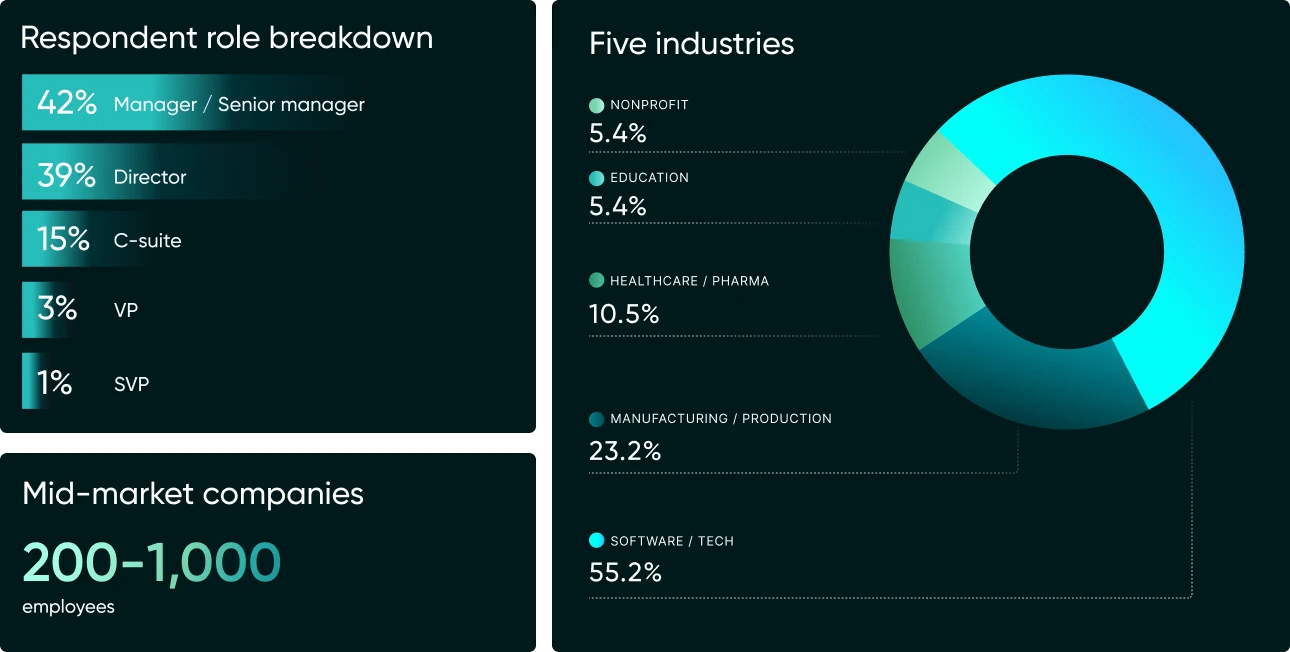
This report is based on a poll of 315 U.S. professionals working in procurement, AP (finance and accounting), operations, and IT at mid-market organizations from a survey conducted in January 2026.
Respondents represent software and technology, manufacturing and production, healthcare and pharma, education, and nonprofit sectors. Roles include managers, directors, and executive leadership across finance-adjacent functions.