
Mastering the Purchasing Process: Everything You Need to Know
A strong purchasing process keeps buying organized, approvals consistent, and invoices easy to pay. This guide walks through each stage—request, approval, PO, receiving, and invoice review—so you can reduce exceptions, speed up cycles, and maintain a reliable paper trail.
The 7 Steps in the Purchasing Process
The purchasing process typically follows these stages:
- Identify the need — confirm what’s required, by whom, and when.
- Select a supplier — research vendors and request quotes or proposals (RFP/RFQ) when needed.
- Submit a purchase requisition — document the request and route it for approval.
- Create and send the purchase order (PO) — formalize quantities, pricing, terms, and delivery details.
- Receive and confirm delivery — verify goods arrived or services were completed as expected.
- Review and approve the invoice — match the PO, receipt, and invoice (three-way match) and resolve exceptions.
- Evaluate supplier performance — track delivery, quality, and issue rates to inform future purchases.
Below, we’ll walk through each stage in detail.
Key stages of the purchasing process
-
Identifying needs
The first step in the purchasing process is understanding what your business needs. This involves various departments collaborating to identify the goods or services required to support daily operations. Whether it’s raw materials for manufacturing, new software for IT, or office supplies, accurately identifying these needs ensures that your purchasing efforts align with the company’s strategic goals.
In larger organizations, procurement teams rely on procurement automation tools to track supply requests and forecast future needs. These tools can analyze historical data, helping businesses identify patterns in consumption and predict future demand. For example, a company that regularly orders packaging materials can use such tools to anticipate when reordering will be necessary, ensuring stock levels are always optimal.
By conducting regular reviews of departmental needs and benchmarking suppliers, companies can avoid over-purchasing and prevent supply shortages, both of which contribute to cost savings.
-
Supplier research and request for proposal (RFP)
After determining the specific business needs, the next step involves sourcing potential suppliers. This step is crucial for finding vendors who can meet your quality, budget, and timeline requirements. Companies typically send out Request for Proposals (RFP) to vendors. These documents outline the specific goods or services the business needs and invite suppliers to submit bids, detailing their ability to fulfill those requirements.
Effective supplier research involves more than just finding the lowest price. Strategic sourcing considers the supplier’s ability to deliver consistently, their reputation in the market, and their long-term reliability. Evaluating factors like lead time, production capacity, and financial stability ensures that you’re building partnerships with suppliers who align with your business goals. Advanced organizations often use e-procurement systems to streamline this process, automating the RFP distribution and bid evaluation.
Automation tools also enable businesses to maintain a list of pre-approved suppliers, which can shorten the procurement cycle by allowing companies to bypass the RFP stage for repeat purchases. Pre-vetted suppliers who have demonstrated consistent performance can be quickly mobilized to meet urgent needs, speeding up the overall process.
-
Purchase requisition and approval workflow
Once a vendor has been selected, the next step is to create a purchase requisition, a formal request to procure the goods or services. In many organizations, purchase requisitions require approval from department heads or finance managers to ensure that the requested purchases align with the budget.
In modern procurement systems, automated purchase approval workflows ensure that all requests undergo the necessary checks and balances without causing delays. For example, if a request exceeds a certain budget threshold, the system automatically routes the requisition to higher management for review. Conversely, low-cost, routine purchases may be pre-approved, reducing time spent on manual approvals.
This stage is essential for maintaining financial control over business expenses and preventing unauthorized purchases. By having a clear workflow in place, companies can avoid “rogue spend” (purchases made outside of approved budgets) and ensure that spending is consistently tracked.
-
Purchase order creation and issuance
Once the purchase requisition has been approved, it is converted into a purchase order (PO). A purchase order is a legally binding document that confirms the details of the transaction, including the quantity of goods, price, payment terms, and delivery schedule.
With modern purchase requisition platforms, the creation and issuance of purchase orders can be automated, eliminating manual data entry errors and speeding up the process. When the PO is ready, it is sent to the supplier, who confirms receipt and begins preparing the goods or services for delivery.
In some cases, companies may skip this step for small, routine purchases, but larger or more complex transactions need to have clear documentation for legal and auditing purposes.
-
Receiving and inspection
Once the goods or services are delivered, it’s critical to inspect them to ensure they match the specifications outlined in the purchase order. This step helps businesses verify that the correct quantity, quality, and type of goods have been delivered.
Organizations often implement quality control measures such as visual inspections or functional tests to detect any discrepancies early on. These measures are essential, especially for high-value goods or components that could impact production or service delivery.
Proper documentation is also maintained at this stage, including delivery receipts and inspection reports, which are vital for supporting payment processing and maintaining an audit trail.
Issues with goods or services may arise, such as damaged products or incorrect quantities. Having an efficient returns or dispute resolution process in place ensures that these problems are addressed swiftly, preventing disruptions in operations.
-
Invoice approval and payment
After receiving and inspecting the goods, the supplier will issue an invoice. This stage requires careful attention to ensure the invoice matches the terms set out in the purchase order and the actual delivery. Companies employ a process called three-way matching to compare the purchase order, delivery receipt, and invoice. If all three documents align, the invoice is approved for payment.
Automating the invoice approval process through Accounts Payable (AP) automation tools can significantly reduce processing time and human errors.
These tools automatically match invoices with corresponding purchase orders and delivery receipts, flagging discrepancies for review. This automation allows businesses to pay their suppliers promptly, maintaining good relationships and often benefiting from early payment discounts.Timely payment is not just beneficial for maintaining a strong supplier relationship; it also helps in managing the company’s cash flow efficiently. Delayed payments can incur penalties, which can hurt both the company’s finances and its rapport with suppliers.
-
Review and supplier performance evaluation
Once the purchasing process is complete and payment has been made, it’s time to evaluate the performance of the supplier. This step is often overlooked but is critical to ensuring that the supplier meets the long-term needs of the business. Key performance indicators (KPIs) such as on-time delivery rates, product quality, and compliance with terms should be tracked regularly.
Supplier performance evaluations help businesses decide whether to continue working with a vendor, negotiate better terms, or even switch suppliers if performance is lacking. For strategic sourcing decisions, this evaluation is crucial in building a reliable supply chain that minimizes risk.
By collecting data on suppliers over time, businesses can also benchmark performance, allowing them to identify top-performing vendors and those that need improvement. This process also supports a more data-driven procurement strategy, where decisions are based on past performance rather than assumptions.
Common challenges in the purchasing process
A purchasing process is designed to improve efficiency, but manual or outdated systems often create the following challenges:
-
Human error
Manual entry mistakes create incorrect orders, mismatched invoices, and delayed payments.
-
Approval delays
Requests stall when routing isn’t standardized, or approvers are unavailable.
-
Siloed teams
A lack of shared visibility leads to duplicate orders and inconsistent supplier communication.
-
No-PO invoices
Invoices arrive without a PO trail, forcing rework and slowing payment.
-
Mismatch exceptions
Price, quantity, or receiving discrepancies break three-way match and require manual resolution.
-
Inconsistent receiving
Missing receipts make it hard to confirm delivery and approve invoices on time.
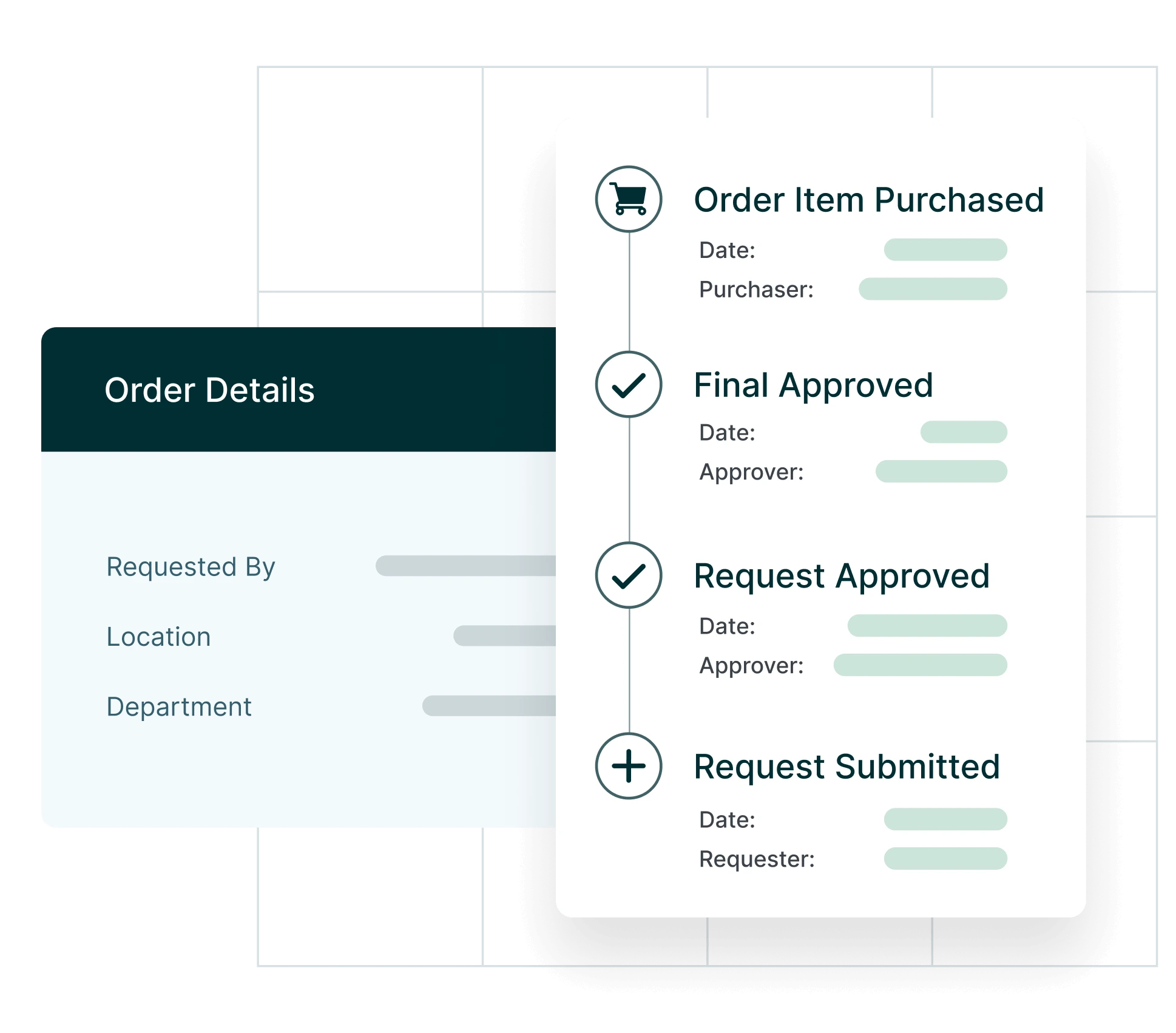
Ready to Automate Your Purchasing Process?
Procurify’s procure-to-pay software automates your company’s purchasing workflow from order creation and approvals to invoice payment – to speed up purchasing, improve internal communication, and minimize financial risk.
Best practices for optimizing the purchasing process
An effective purchasing process is repeatable, easy to follow, and produces clean documentation from request to payment. These best practices help you build that consistency across teams.
Embrace automation
Automation helps keep the purchasing workflow moving by routing requests to the right approvers, generating accurate purchase orders from approved requests, and supporting reliable invoice matching. It also gives teams shared, real-time visibility into order status, approvals, and what’s ready for payment—so fewer steps depend on manual follow-ups.
Standardize the workflow
Standardization makes purchasing predictable. Define what information every request must include (vendor, items, budget owner, delivery timing), set clear approval thresholds, and use consistent PO formats and coding rules. With a standard flow, teams can submit requests correctly the first time, and finance can review transactions faster and more consistently.
Clarify PO rules and exceptions
Clear PO rules prevent confusion later. Deploying purchase order solutions can help you define when a PO is required (by spend threshold, category, or vendor type) and what happens when a purchase bypasses the normal path. When teams know the default route—and the exception path—purchasing stays consistent without slowing down urgent needs.
Strengthen supplier coordination
Clear supplier expectations reduce back-and-forth and keep orders on track. Align on ordering requirements, lead times, invoice formats, and who owns updates when something changes. Regular check-ins and performance reviews also help improve fulfillment quality over time and make repeat purchases smoother.
Make receiving and exception handling consistent
A clean payables trail depends on consistent receiving and clear ownership when something doesn’t match. Set a simple standard for confirming delivery (goods receipt or service confirmation) and define who resolves common exceptions like price variances, partial deliveries, missing receipts, or vendor mismatches.
Use data and analytics to improve performance
Spend analytics can help you refine the process over time. Track cycle time, exception rates, and supplier performance to see where the workflow can be streamlined, where standard options should be introduced, and which vendors consistently deliver the best results. Over time, this creates a faster, cleaner purchasing cycle with fewer manual interventions.
7 KPIs to measure purchasing effectiveness
To keep the purchasing process efficient, predictable, and easy to audit, it helps to track a small set of P2P KPIs that reflect how quickly work moves—and how often it gets stuck.
Key purchasing KPIs include:
1. Purchasing cycle time
Measures how long it takes to go from request to order placement (and, in some cases, through delivery). Shorter cycle time usually means approvals and PO creation are working smoothly.
2. PO processing time
Tracks how quickly approved requests become accurate purchase orders. This highlights bottlenecks in ordering and PO creation.
3. On-time delivery rate
Measures how often suppliers deliver by the agreed date. A strong on-time rate reduces follow-ups, expediting, and downstream disruption.
4. Invoice exception rate
Shows the percentage of invoices that require manual intervention (price mismatches, missing receipts, incorrect vendor, etc.). Lower exception rates mean cleaner documentation and faster invoice processing.
5. Three-way match rate
Measures how often the PO, receipt, and invoice match without rework. This is one of the clearest indicators that purchasing and receiving processes are producing a reliable paper trail.
6. No-PO invoice rate
Tracks how often invoices arrive without a PO. A lower rate usually signals better process adoption and stronger controls.
7. Supplier performance
Monitors supplier reliability over time (quality issues, responsiveness, dispute frequency), which helps reduce exceptions and improve purchasing consistency.
By tracking and benchmarking these KPIs consistently, teams can spot where the process slows down, reduce preventable exceptions, and keep purchasing activity organized from request through payment.
Conclusion
A strong purchasing process is a repeatable workflow that moves from request to approval to PO to receiving to invoice review. When those steps are consistent, teams spend less time fixing mismatches and more time keeping orders on track and invoices ready to pay.
The purchasing process plays a critical role in how organizations control spending and maintain operational efficiency. From identifying needs and selecting suppliers to issuing purchase orders, confirming delivery, and reviewing invoices, each step helps create the documentation and accountability required for accurate payments.
When these stages are standardized and supported by automation and clear policies, purchasing becomes faster, more transparent, and easier to manage. Businesses that invest in improving their purchasing process gain better spend visibility, fewer invoice exceptions, and stronger supplier partnerships over time.
See how the purchasing process fits into procure-to-pay
Purchasing is one part of the broader procure-to-pay workflow. Understanding how requests, purchase orders, receiving, and invoice matching connect can help teams reduce exceptions and improve spend visibility. Learn more about the procure-to-pay process.

Preview AI Intake for Orders
Take the product tour to see how the new intake experience works.