Spend Management vs Expense Management: Is There a Difference?
Ask a vendor whether their platform is spend management or expense management, and the answer is increasingly likely to be both. Modern expense tools can put controls in place around employee spending before a transaction occurs, while broader spend management platforms increasingly bring procurement, cards, expenses, budgets, and accounts payable into a single system. The capabilities overlap more than they once did, which is one reason the terminology can be difficult for buyers to untangle.
Spend management is the broader discipline of controlling and understanding how an organization uses money: procurement and purchasing, supplier and contract management, budgeting, accounts payable, spend analysis, and employee expenses all fall under it.
Expense management is one specific part of that discipline, focused primarily on employee expenses, reimbursements, and card-based spend. Rather than asking which label sounds more comprehensive, a business evaluating software is better off asking which part of the spending process is causing the problem it needs to solve.
| Spend management | Expense management | |
|---|---|---|
| Scope | Organization-wide spend across procurement, purchasing, budgets, suppliers, AP, expenses, and reporting | Employee expenses, reimbursements, card spend, and the policies and approvals around them |
| Typical workflows | Purchase requests, approvals, purchase orders, supplier and contract management, budgets, payments, and spend analysis | Expense reports, receipt capture, reimbursements, spending cards, policy checks, approvals, and reconciliation |
| Typical problem | Limited control over commitments, supplier spend, budgets, or purchasing decisions across the business | Too much manual work around employee expenses, missing receipts, reimbursements, card transactions, or policy compliance |
| When control happens | Across the full spend lifecycle, including before and after a purchase is committed | Traditionally after employee spend, but increasingly before transactions too through card limits, policies, and approvals |
| Main question it answers | How do we control and understand company spend as a whole? | How do we control, document, and reconcile employee-initiated spend? |
Spend management’s side of the line
The broader discipline of spend management spans the full lifecycle of organizational spend, not just the moment before a purchase happens. That includes procurement workflows, a request raised, routed, and approved before a purchase order goes out, contract and supplier management to make sure what actually gets billed matches what was negotiated, budgets that set what a department is allowed to spend in the first place, and spend analysis that shows committed and forecasted spend across the business. It also includes what employees spend directly through reimbursements and cards, which is where expense management sits: one part of the same picture, not a separate discipline running alongside it.
Expense management’s side of the line
Expense management is the part of spend management that deals primarily with employee-initiated spend: the field technician paying out of pocket for a replacement part at a local hardware store because the job can’t wait for a formal purchase order, the software subscription bought on a personal card, or the travel expense that doesn’t fit cleanly into a procurement process. Traditionally, much of this was handled through a reimbursement model, tracked via what most companies still call expense reporting software: an employee pays out of pocket, submits a report, and waits to be reimbursed. Expense reporting is really one workflow inside expense management, the mechanism for turning a receipt into a reimbursement rather than a separate category of its own.
Expense tracking is narrower still, and worth separating from both. It’s the record-keeping piece alone: logging what was spent, by whom, and against which budget line, without necessarily enforcing a policy or routing anything for approval. A spreadsheet that tags every card transaction by department is doing expense tracking. It becomes expense management once a policy is enforced against that record, a submission routes to the right approver, and reimbursement or reconciliation follows through a defined workflow rather than relying on someone to remember to check.
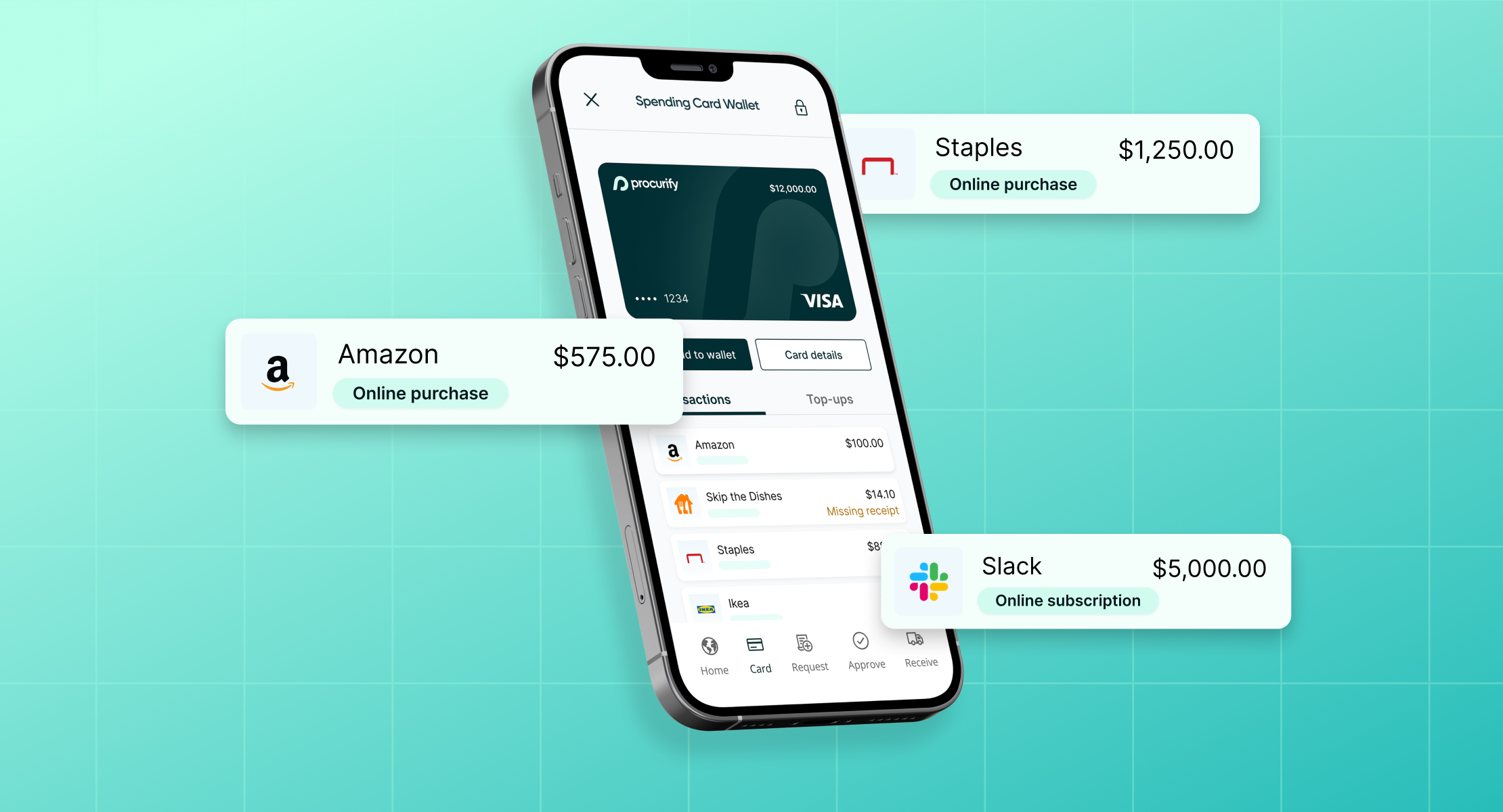
Modern expense management can also put controls around spend before the transaction happens. Moving spend onto a Spending Card allows a limit to be set in advance for a person, department, or project, with the transaction reviewed afterward rather than reimbursed after a wait. That’s still expense management because the focus is employee-initiated spend rather than the sourcing decision itself, but it removes a major source of friction in the traditional reimbursement model: asking an employee to front their own money for something the company is prepared to pay for.
Where procurement fits in
Procurement is another major part of spend management, and it’s often what’s missing when someone asks how spend management differs from expense management. Procurement covers activities such as identifying and sourcing suppliers, negotiating contracts, approving purchases, and issuing purchase orders before money is committed. Depending on the organization, it can also extend into ongoing supplier and contract management after the initial purchase.
Expense management sits alongside those workflows and often handles purchases that don’t go through a formal sourcing or purchase order process at all: smaller, more immediate, employee-driven spend that still needs to be controlled, documented, and reconciled. That kind of spend can be easy to underestimate because it rarely arrives as one large commitment; it accumulates across many individual transactions.
A company can run excellent procurement and still reconcile expense reports by hand every month because the two solve different problems within the same broader spend management picture. When they run on the same platform and share the same underlying budgets, the operational boundary can become less visible, even though the workflows themselves remain distinct.
What this looks like in an actual purchase
The distinction becomes easier to see when the same company has different kinds of purchases happening at once. The deciding factor isn’t simply whether a card was used or whether approval happened before the transaction. It’s what kind of spending decision the business is trying to control.
| Purchase | What needs to be controlled | Where it primarily sits |
|---|---|---|
| A department wants to sign a $40,000 annual software contract | Vendor selection, budget availability, contract terms, approval, and the resulting commitment | Procurement within spend management |
| An employee pays for a client dinner while travelling | Whether the purchase is within policy, whether documentation is complete, and how it is coded and reimbursed | Expense management |
| A field employee needs a $300 replacement part immediately | Whether the employee is authorized to spend the money, how much they can spend, and which budget it should come from | Expense and card management, even if approval happens before the transaction |
| A department renews an existing supplier contract | Whether the contract should renew, whether pricing and usage still make sense, and whether budget remains available | Procurement, contract management, and spend management |
The third example is where the terminology gets especially messy. A pre-approved card transaction has a control in place before money moves, but that doesn’t automatically make it a procurement transaction. No supplier was necessarily sourced, no contract was necessarily negotiated, and no purchase order may have been created. The employee is still making the transaction; expense management has simply moved some of its controls upstream.
That’s why “before the purchase” versus “after the purchase” is no longer a reliable way to distinguish the categories on its own. A more useful test is to ask what is being governed: a supplier and purchasing commitment, an employee transaction, or the company’s total spend across both.
Which problem do you actually have?
Most organizations need some combination of spend management, procurement, and expense management. The more useful question is where the actual pain sits today.
Misdiagnosing that problem can lead a team to evaluate the wrong capabilities. A business whose immediate problem is employees fronting personal money, missing receipts, and slow reimbursements may not need the same solution as one struggling with uncontrolled supplier commitments, contract renewals, or purchases being approved without enough budget visibility. The opposite can happen too: making employee card spend easier does not solve weak supplier or procurement controls elsewhere in the business.
Spend that needs controlling before it’s committed
If most of your company’s money is committed through vendor contracts, purchase orders, and negotiated terms, a gap here can show up as supplier spend that isn’t visible early enough, departments committing to vendors independently and weakening negotiation leverage, or budgets being consumed by purchases before finance has a clear view of what has already been committed. That’s a spend management gap on the procurement side specifically.
Sometimes the failure is easy to laugh at and still worth taking seriously. One Procurify customer, before putting a system in place built to catch this kind of thing, found out after the fact that someone in the organization had signed off on a $60,000 couch. Nobody with budget authority saw that purchase coming. The company only learned about it once the money was already spent, probably when a statement or an invoice landed on the right desk. A purchase that size should have needed someone to say yes before it happened, not explain it after the fact, and whatever was supposed to require that approval either wasn’t in place or got skipped. That’s the real lesson underneath the joke: if the only way a company finds out what it spent is by looking backward, there’s no way to stop the next surprising purchase before it happens either.
Buried in receipts and reimbursement follow-up
If finance is chasing missing receipts, correcting miscoded reimbursements, or explaining why a travel expense report took three weeks to close, the gap sits in expense management. It often appears as a people problem first: someone spending hours each week on work that a policy and an approval workflow could handle more consistently. Recovering that time is one of the more measurable benefits of expense management software once it’s actually in place.
Do you need visibility across both?
Some companies have pain concentrated mainly on one side and can address that gap directly. Others find that procurement controls are working reasonably well while expense processes are not, or vice versa. In those cases, the larger issue may be visibility across both rather than either workflow in isolation.
That gap becomes obvious when a department head can explain their card spend during a budget review but has no visibility into what’s already committed through open purchase orders, or when procurement can see every PO but finance still has to wait until month-end to understand employee card and reimbursement spend.
What to look for when you need both
If your organization has problems on both sides of the line, the goal isn’t simply to find software with a long enough feature list. It’s to make sure purchasing and employee spend don’t create separate versions of the truth for finance.
Look at what happens when a purchase moves from request to commitment to payment. Can finance see an approved purchase order alongside card and reimbursement spend before a budget is exhausted? Do the same approval rules follow spend regardless of how someone buys? Can a budget owner see what has already been committed and what has already been spent? Those connections matter more than whether a vendor calls its product spend management, expense management, or both.
The $60,000 couch is an extreme example, but the underlying problem is ordinary: a company can only control the spend it can see at the point when someone still has a chance to make a different decision.
If that’s the gap you’re trying to close, take the interactive expense management product tour to see how purchasing, employee expenses, cards, approvals, and budgets can work together instead of being reconciled after the fact.
$30B+ in real spend data you won’t get anywhere else
Find out what it takes to move from reactive to AI-driven operations.