


What Is Spend Management: How It Works and Why It Matters
Spend management is how organizations plan, control, and analyze company spending across its full lifecycle — from the moment a purchase is requested to when it’s paid, reported on, and optimized.
At its core, spend management exists to answer a simple but increasingly critical question:
Do we know where our money is going, and can we influence it before it’s spent?
As organizations grow, spending becomes fragmented across departments, tools, and processes. Finance teams are left reconciling transactions after the fact, while procurement teams struggle to enforce policies upstream. Spend management closes that gap by bringing visibility, control, and accountability into a single operating model.
Spend management, defined
Spend management is a systematic approach to managing business spend before, during, and after it happens. It integrates budgeting, purchasing, approvals, payments, and analysis into a single continuous process.
Unlike traditional expense tracking or procurement tools that operate in silos, top spend management software solutions focus on the entire spend lifecycle, including:
- Intake and approvals (what people want to buy and why)
- Procurement and purchasing (how and from whom it’s bought)
- Expense and invoice processing (how it’s paid)
- Spend analysis and reporting (what the data reveals over time)
The goal isn’t just cost reduction. It’s spend control without slowing the business down — enabling teams to move fast while finance maintains oversight.
Spend management vs. expense management vs. procurement
These terms, spend management, expense management, and procurement, are often used interchangeably, but they solve different problems at different points in the spending lifecycle.
Expense management
Expense management focuses on employee-driven spending after money has already been spent. This includes reimbursements, corporate cards, and travel and entertainment expenses. Its primary purpose is to capture transactions, enforce policy, and reconcile spending for reporting and reimbursement.
Expense management answers the question:
“Was this spend compliant after it happened?”
Procurement
Procurement governs how goods and services are sourced and purchased. It covers vendor selection, contract negotiation, pricing, and purchase orders. Essentially, what procurement does is secure value and manage supplier relationships before purchases occur.
Procurement answers the question:
“Are we buying the right things from the right vendors?”
Spend management
Spend management connects these activities into a single, end-to-end system that governs spending before, during, and after it happens.
It ensures:
- Procurement decisions align with approved budgets
- Expenses follow policy and approval workflows
- Invoices match what was ordered and approved
- Finance teams can analyze spend in real time, not weeks later
Spend management answers the question:
“Do we have visibility and control over spending across its full lifecycle?”
In short, procurement and expense management are inputs.
Spend management is the operating system that ties them together.
Key processes in business spend management
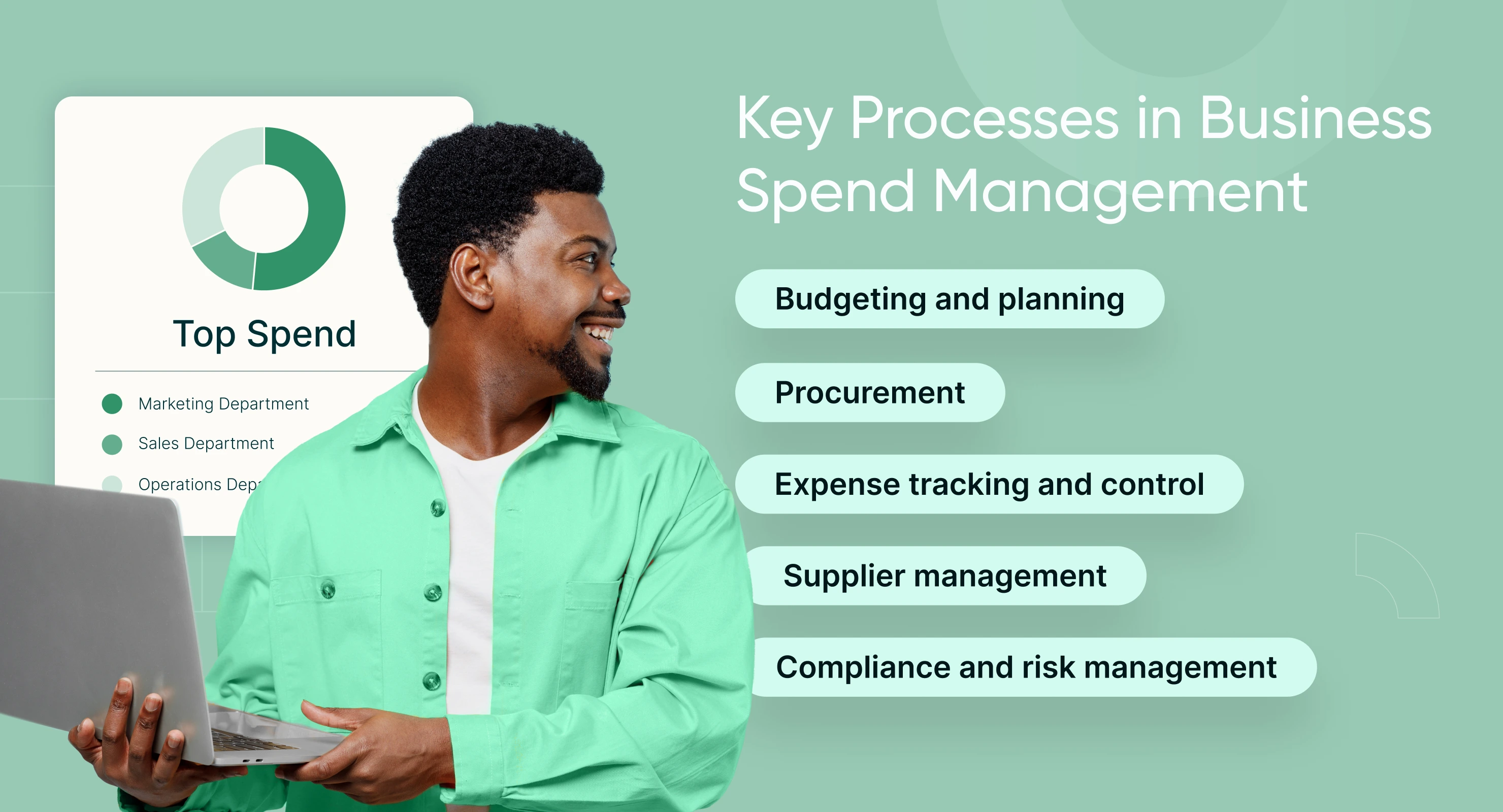
Spend management works as a connected lifecycle, not a set of isolated functions. Each process reinforces the next to maintain control, visibility, and accountability as money moves through the organization.
-
1. Budget definition and spend guardrails
Spend management begins with clear budgets tied to departments, projects, or cost centers. These budgets establish guardrails before spending occurs, making it possible to evaluate requests in context rather than after the fact.
When budgets are visible at the point of decision, company spend can be controlled more easily without finance intervention.
-
Intake, approvals, and purchasing
Once budgets are set, spending flows through structured intake and approval processes. Requests are reviewed against policy, thresholds, and available budget before purchases are made.
This step is where spend management exerts the greatest leverage: preventing unauthorized purchases, reducing duplicate orders, and ensuring that purchasing decisions align with business priorities.
-
Procurement and supplier governance
Spend management supports procurement by centralizing vendors, contracts, and pricing. This enables organizations to standardize buying, negotiate more effectively, and manage supplier relationships with greater consistency.
Supplier governance ensures purchases reflect agreed terms and performance expectations, reducing risk and variability across the supply base.
-
Expense, invoice, and payment control
After purchases are made, spend management ensures that expenses and invoices are processed accurately and efficiently. Matching invoices to approved purchases, enforcing policy, and routing exceptions correctly helps reduce errors, delays, and internal friction.
This stage maintains financial discipline without slowing operations.
-
Compliance, risk, and accountability
Throughout the lifecycle, spend management enforces internal policies and regulatory requirements. Approval trails, documentation, and exception handling create accountability for spend decisions and reduce exposure to fraud, non-compliance, and audit risk.
Rather than relying on manual reviews, controls are embedded directly into workflows.
Why modern spend management requires technology
Spend management evolved because manual, fragmented systems could no longer keep up with how and when spending decisions are actually made. As purchasing spread across departments, tools, and locations, spreadsheets, ERP-only workflows, and after-the-fact expense reports lost the ability to influence spend before funds were committed or paid.
That is the massive benefit of spend management technology: it closes the gap by introducing controls at the point of request, visibility into committed spend, and continuous insight across purchasing, expenses, and payments.
-
Automation: shifting control upstream
Modern automation shifts control upstream by embedding policy enforcement, approvals, and budget validation into the moment spending decisions are made.
Automation now plays a role across the entire spend lifecycle, including:
- Intake and purchase request routing, including AI-powered intake for purchase requests
- Policy-driven approvals and exception handling based on role, category, and thresholds
- Invoice matching and exception resolution to ensure purchases align with what was approved
- Continuous budget validation as requests are submitted and obligations are created
Crucially, modern automation makes spending policies enforceable by default—not dependent on manual review or finance intervention. This reduces reliance on after-the-fact controls and prevents issues before they become accounting problems, marking a shift from reactive to preventative spend control.
-
AI-powered spend insights: from reporting to decision support
AI-powered spend analysis tools deliver the insight to focus on what’s happening and what’s likely to happen next.
By analyzing historical trends alongside real-time spend data, AI can:
- Detect anomalies, fraud signals, and emerging compliance risks
- Identify patterns across vendors, categories, departments, and cost centers
- Surface recurring inefficiencies and policy exceptions that warrant change
- Anticipate budget pressure and forecast likely overruns
Instead of relying on static dashboards and manual analysis, finance and procurement leaders gain continuous, forward-looking insights that support better decisions—not just better reporting.
This shift is already visible among more mature organizations. In a recent survey, cost management owners were significantly more likely to use AI to identify cost-reduction opportunities than those in supporting roles—a signal that teams responsible for outcomes prioritize insight-driven decision-making over after-the-fact reporting. (Source: Deloitte / WSJ Finance Trends 2026)
-
Real-time visibility: seeing spend in time to act
One of the biggest limitations of legacy spend processes is timing. By the time finance teams see spend data, the purchasing decision has already been made — and often paid.
Modern spend management platforms solve this by making spend visible as it is committed, not weeks later during reporting cycles.
They provide:
- Live views of committed and actual spend across departments and cost centers
- Budget consumption tracking as requests, POs, and expenses are created
- Immediate visibility into pending approvals, exceptions, and obligations
This real-time access enables finance and procurement teams to intervene before budgets are exceeded or policies are violated, turning spend data into an operational control layer rather than a retrospective report.
-
Integration with financial systems: creating a single spend record
Spend data traditionally lives across procurement tools, expense platforms, AP systems, and ERPs. When these systems aren’t connected, visibility and accountability break down.
Modern spend management integrates directly with:
- ERP and accounting platforms
- AP and payment systems
- Procurement and sourcing tools
This creates a single, consistent record of spend, improving data accuracy, reducing reconciliation effort, and enabling reliable governance and analysis across finance.
-
Cloud and mobile access: enabling decentralized spending
As spending authority becomes more distributed, accessibility matters.
Cloud-based and mobile spend management tools allow employees to:
- Submit requests and expenses from anywhere
- Approve purchases and policy exceptions without bottlenecks
- Track spend in real time across teams and locations
This ensures controls, policies, and accountability scale with the organization, without slowing teams down or encouraging workarounds that undermine visibility.
Compare Spend Management Solutions
See how modern spend management platforms differ—and what to prioritize as your organization scales.
What effective spend management enables
When spend management is implemented well, the impact goes beyond cost control. It changes how decisions are made, how spending is governed, and how confidently the organization operates.
Predictable financial outcomes
With visibility into requested, approved, and committed spend, finance teams stop discovering problems at month-end. Budgets hold because spending decisions are evaluated before money is committed, enabling more reliable forecasting and planning.
Speed with discipline
Clear intake, approval, and policy guardrails allow teams to move faster because controls are built in. Decisions happen in context, without constant escalation, rework, or manual enforcement.
Clear ownership and accountability
Every purchase is tied to a person, budget, and purpose. This makes spend decisions traceable and defensible, reducing friction between finance, procurement, and the rest of the business.
Finance as a strategic partner
As controls become embedded in workflows, finance and procurement teams spend less time policing spend and more time advising the business, improving planning, prioritization, and long-term spend strategy.
Frequently asked questions (FAQs)
$30B+ in real spend data you won’t get anywhere else
Find out what it takes to move from reactive to AI-driven operations.


