

The Benefits of E-Procurement: Is It Worth the Investment?
Cost optimization and forecast accuracy sit behind nearly every finance board conversation. Purchasing is one of the few areas where both can improve at the same time, but only if finance can see commitments before they become liabilities. When purchasing happens outside a structured process, costs are harder to control, forecasts are harder to trust, and variance is harder to explain. E-procurement moves financial oversight upstream, to the point where a purchasing decision is made rather than the point where the invoice arrives. That is why its benefits show up in the numbers finance teams are already accountable for: budget variance, savings capture, working capital, audit exposure, and forecast accuracy.
The financial benefits of e-procurement
The financial case for e-procurement software rests on five outcomes that change what a finance team can see, defend, and act on.
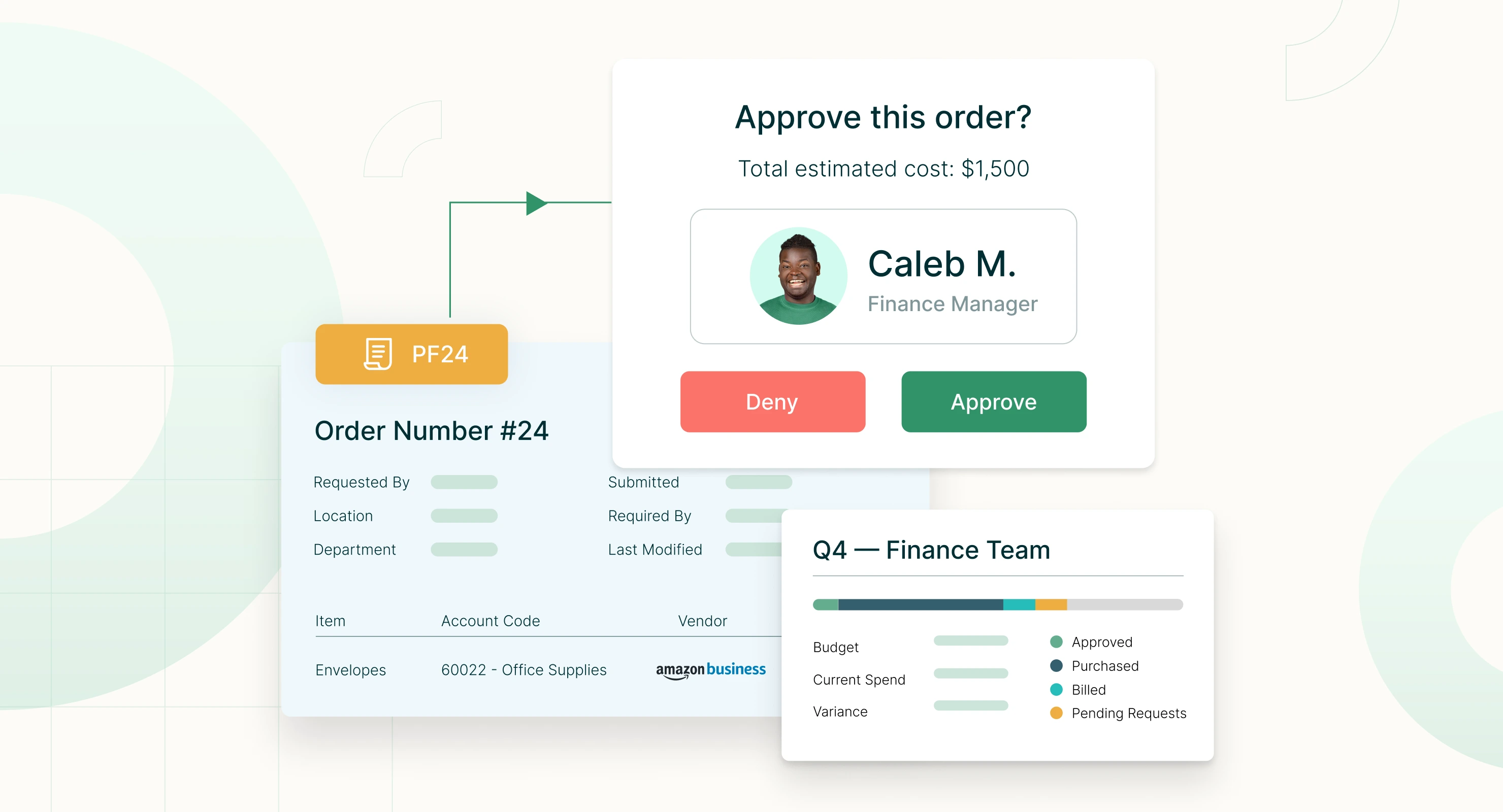
Budget variance narrows. When every purchase request is captured as a documented commitment against a specific budget before money moves, encumbered spend is visible in real time. Finance is no longer forecasting from a lagging record of invoices already processed.
Savings capture improves. Contracted pricing and preferred supplier agreements are enforced at the point of purchase rather than reviewed after the fact. The gap between negotiated cost and actual cost closes because the system makes the compliant purchase the easiest purchase.
Days payable outstanding becomes more manageable. When invoices arrive against existing purchase orders, exceptions are caught before payment rather than discovered after. AP processing becomes predictable, and DPO becomes a deliberate working capital decision rather than a function of processing friction.
Audit exposure decreases. Every financial commitment is documented at the moment it is made. The audit trail exists as a natural output of the purchasing process, not as something assembled under pressure when a review is imminent.
Forecast accuracy improves. When purchasing data is complete, connected, and current, the information feeding FP&A reflects actual organizational behavior rather than estimates built from whatever invoices have cleared by the time the cycle runs.
Budget variance narrows when committed spend is visible in real time
Finance leaders cannot forecast accurately from data that arrives late. When purchasing commitments are invisible until invoices clear accounts payable, budget variance is wide by definition. The actuals surprise not because spending was undisciplined but because the commitments were never on record when forecasts were built. FP&A cycles built on invoice history are always looking backward, and the further back they look, the less useful they are for decisions that need to be made now.
When every purchase starts as an approved, documented commitment against a specific budget, encumbered spend is visible in real time. The CFO sees what is committed alongside what has been paid. Budget variance narrows because the data feeding forecasts reflects actual organizational behavior as it happens rather than a lagging record of invoices already processed. Accruals at period close are more accurate. Month-end assembly work falls because the record is built continuously, not reconstructed at the end of the period.
Reliable forecasting is not just an operational improvement. It is a board-level deliverable. Finance leaders who can explain budget variance in real time rather than reconstruct it at period close are operating from a fundamentally different information position. The organizations they run are making budget and sourcing decisions from current data rather than from the best available approximation of what happened last month.
Negotiated savings actually show up in actuals
Negotiated savings have a realization gap in most organizations. The procurement team secures preferred supplier agreements and contracted pricing. Finance books the expected savings against budget. Then purchasing happens across departments without a system connecting those contracts to actual purchasing decisions. Employees buy from whoever responds fastest or whoever they have bought from before. The contracted supplier goes unused. The contracted price goes unenforced. The savings never materialize in actuals.
The gap between negotiated cost and actual cost is quiet EBITDA erosion. It does not appear on a single transaction. It accumulates across hundreds of indirect spend decisions made by people with no mechanism to know whether a supplier is preferred or a price is contracted. By the time the pattern becomes visible in spend analysis, the margin has already been lost.
E-procurement closes the gap by connecting contracts to purchasing decisions at the moment they are made. Preferred vendor controls enforce supplier selection before the purchase order is created. Off-contract spend falls not because employees are more disciplined but because the system makes the right choice the default choice. Savings capture improves. Operating margin reflects the terms the organization actually negotiated rather than the distance between what was planned and what was spent.
AP processing becomes faster and DPO becomes a deliberate decision
AP efficiency and DPO management both depend on clean invoice processing. When invoices arrive without matching purchase orders, accounts payable teams spend time locating approvals that may not exist in any retrievable form, verifying receipt of goods, correcting GL coding entered incorrectly upstream, and resolving discrepancies before payment can be released. Payment delays follow. The cash conversion cycle extends not because of payment strategy but because of processing friction that has nothing to do with payment decisions.
When purchase orders exist before invoices arrive, AP automation validates invoices automatically against the PO and the receiving record. Invoices that match clear without manual intervention. Exceptions are flagged before payment, not discovered after money has already left the organization. AP processing time falls and payment cycles become predictable rather than dependent on how long each exception takes to resolve.
The CFO outcome is that DPO becomes a deliberate working capital lever. Finance can manage payables intentionally when the processing layer beneath them is not the constraint. Faster, cleaner AP processing with fewer exceptions creates the predictable payment cycles that working capital optimization requires.
Audit exposure decreases because the trail builds itself
Audit exposure in a manual purchasing process is structural. Internal controls that depend on email approvals, paper receipts, and verbal authorizations cannot produce a complete, consistent audit trail on demand. When a regulator, acquirer, or auditor asks for documentation on purchasing decisions, the answer is a reconstruction exercise rather than a retrieval exercise. The risk is not that controls did not exist. It is that they cannot be demonstrated when they need to be.
E-procurement captures every financial commitment automatically at the moment it is made. The approval chain, the purchase order, the receiving confirmation, and the invoice match are connected in a single record without anyone assembling them. Compliance is not something prepared for a review. It is visible throughout the year as a natural output of the purchasing process. Internal controls are demonstrable on demand rather than assembled under pressure when they are needed most.
For organizations subject to investor scrutiny, regulatory oversight, or acquisition due diligence, this changes the nature of financial risk exposure entirely. For nonprofits managing restricted grant funds, charter schools subject to authorizer compliance requirements, and biotech organizations reporting to investors, the stakes are higher still. Documentation that cannot be produced is documentation that did not exist, and the financial and funding consequences of that gap are not recoverable after the fact.
Supplier negotiations start from better evidence
Supplier negotiations are only as strong as the data behind them. When purchasing is fragmented across departments, finance and procurement may know what was supposed to happen under contract, but not what actually happened in day-to-day buying. Spend gets spread across too many vendors, preferred suppliers are bypassed, and pricing differences stay hidden until the next analysis cycle.
E-procurement gives the organization a clearer record of supplier behavior. Finance can see where spend is concentrated, where it is leaking to off-contract vendors, and where volume could be consolidated before the next negotiation. That changes the supplier conversation from anecdotal to evidence-based.
The benefit is not just better reporting. It is stronger negotiating power. When finance can show actual purchase volume, contract compliance, pricing variance, and category-level demand, the organization enters supplier conversations with a clearer view of what it can ask for and where the financial opportunity sits.
Rogue spend breaks the assumptions finance used to build the budget
Rogue or maverick spend extends well beyond a policy issue. It is a big budgeting issue. When employees buy outside approved suppliers or approval paths, the spend may still serve a legitimate business need, but it no longer follows the financial assumptions used to build the plan.
That creates a gap between what finance expected and what the organization actually did. A budget may assume contracted pricing, preferred vendors, or approved category limits, but informal purchasing can move spend away from those assumptions before finance sees it. By the time the issue appears in actuals, the money has already been committed.
E-procurement reduces rogue spend by moving the control point earlier. Purchase requests, budget checks, preferred suppliers, and approval rules all sit in the same workflow, so spend is reviewed before the organization is committed. Finance gets a chance to manage the decision while it is still a request, not after it has become an invoice.
Cleaner ERP data starts before the transaction posts
The ERP is only as clean as the data that enters it. When purchasing happens informally, AP often becomes the cleanup team for missing approvals, inconsistent coding, incomplete supplier details, and invoice discrepancies. Those issues do not disappear when they reach the system of record. They make reporting harder to trust.
E-procurement improves ERP data quality by capturing the right information before the transaction posts. Approved suppliers, GL codes, departments, budgets, purchase orders, receiving records, and invoices are connected earlier in the process. That reduces the amount of correction work required after the fact.
The ERP remains the financial system of record, but e-procurement improves the quality of the transactions flowing into it. That matters for close, reporting, forecasting, and AI-driven analysis because the output is only as reliable as the data behind it.
Getting the most from e-procurement starts with adoption
The financial benefits of e-procurement are only realized when purchasing behavior actually moves through the system. Organizations that see the strongest results treat implementation as much a change management exercise as a technology deployment. That means designing the new purchasing process to be faster and simpler than the informal one it replaces, so employees adopt it because it is easier, not because policy requires it. When the system becomes the path of least resistance, purchasing behavior follows and the financial controls hold.
Ease of adoption depends on whether the platform works for the people submitting requests every day, not just the finance team configuring it. A researcher, a teacher, or a field worker will not consistently use a system that adds friction to their day. When it does not, purchasing drifts back to informal channels and the financial visibility the organization invested in disappears with it.
The most cited reason organizations choose Procurify over more complex alternatives is that their teams actually use it.
If that is the outcome you are looking for, speak with the team about what the implementation will look like for your organization.
Frequently asked questions about the benefits of e-procurement
What is the main financial benefit of e-procurement?
The primary financial benefit is earlier visibility into committed spend. When every purchase starts as a structured request routed through an approval workflow, finance can see what is pending before money moves rather than discovering what was spent when the invoice arrives. This earlier visibility makes budget forecasting more reliable, cost-control decisions more timely, and month-end close less dependent on manually assembling documentation after the fact.
How long does it take to see a return from e-procurement software?
The clearest early indicators appear within the first quarter: AP processing time, approval turnaround, and the percentage of spend tied to purchase orders. Longer-term benefits, including contract compliance rates, spend under management growth, and supplier negotiating strength, build as more purchasing behavior moves through structured workflows.
Does e-procurement replace the ERP?
No. E-procurement software sits in front of the ERP as the purchasing workflow layer. It manages the process from purchase request through payment and pushes clean, correctly coded transactions into the ERP when complete. The ERP remains the system of financial record. Procurify integrates natively and bidirectionally with QuickBooks Online, NetSuite, Sage Intacct, and Microsoft Dynamics 365.
$30B+ in real spend data you won’t get anywhere else
Find out what it takes to move from reactive to AI-driven operations.


