

How to Choose the Best Contract Management Software for Your Organization
Contracts are the foundation of business—governing deals, partnerships, and operations. Yet, managing them manually often means chasing approvals, missing deadlines, and struggling with version control. A misplaced contract or an overlooked renewal can lead to costly mistakes, compliance risks, and lost opportunities.
That’s where contract management software comes in. These digital tools streamline the entire contract lifecycle—automating approvals, tracking key dates, and ensuring compliance—so businesses can focus on growth instead of paperwork.
In this guide, we’ll explore the best contract management applications, breaking down key features, top solutions, and how to choose the right fit. By the end, you’ll have the insights you need to take control of your contracts and avoid unnecessary risks.
What is contract management software?
Before we dive in, let’s start with a basic definition.
A contract management application is a digital tool designed to help businesses create, store, track, and manage contracts efficiently. Instead of relying on paper files, spreadsheets, or email chains, companies can use contract management software to centralize their agreements and automate key processes. This reduces errors, saves time, and ensures that important deadlines are never missed.
Challenges that contract management systems help solve
Traditional contract management often involves stacks of paper documents, scattered email attachments, or spreadsheets that require constant updating. This manual approach creates risks, such as:
-
Lost or misplaced contracts – Important agreements can be difficult to locate.
-
Missed deadlines – Without automated alerts, renewals and expirations can slip through the cracks.
-
Version control issues – Tracking contract revisions manually can lead to costly mistakes.
-
Compliance risks – Keeping up with legal and regulatory changes is challenging without automated tracking.
A contract management application eliminates these issues by offering a centralized, automated system where businesses can securely store and manage all contracts in one place.
Key functions of a contract management application
Managing contracts manually can lead to lost documents, missed deadlines, and compliance risks. A contract management application centralizes and automates key processes, ensuring contracts are properly handled from creation to renewal.
With all contracts stored in a secure, searchable repository, businesses can quickly retrieve documents when needed. Automated tracking and reminders help teams stay ahead of key dates like expirations, renewals, and payment milestones. Instead of chasing signatures or approvals through endless email threads, contract templates and workflow automation streamline the entire process—reducing delays and keeping deals moving forward.
Key functions of a contract management application include:
-
Centralized storage – Keep all contracts in a secure, searchable repository for easy access.
-
Automated tracking and reminders – Get alerts for contract expirations, renewals, and payment deadlines.
-
Contract creation and approval workflows – Use templates and automation to speed up execution.
-
Compliance management – Ensure contracts meet regulatory and internal policy requirements.
-
E-signature integration – Finalize agreements faster with legally binding electronic signatures.
-
Reporting and analytics – Gain insights into contract performance, obligations, and risks.
By replacing manual contract handling with automation, businesses can improve efficiency, reduce risk, and gain better control over their agreements. Better contract visibility also strengthens vendor relationships by ensuring timely payments, clear expectations, and seamless renewals.
The benefits of contract management software
The best contract management software does more than just organize agreements—it streamlines processes, reduces risk, and drives efficiency. By automating key tasks and ensuring compliance, businesses can save time, cut costs, and gain better control over their contractual obligations.
-
Time savings through automation and reminders
Manual contract management requires constant tracking of deadlines, approvals, and renewals. A contract management application automates these tasks, sending reminders for upcoming expirations and streamlining approval workflows. Instead of chasing signatures or updating spreadsheets, businesses can focus on higher-value work.
-
Cost savings by avoiding missed renewals and reducing admin work
Contract mismanagement can lead to costly auto-renewals, late fees, and penalties—avoidable expenses that add up over time. Beyond that, administrative time spent manually tracking contracts translates into lost productivity. According to the International Association for Contract & Commercial Management (IACCM), poor contract management costs businesses an average of 9% of their annual revenue due to inefficiencies and missed opportunities.
One Procurify customer saw this play out directly. After finally getting visibility into a long-standing supplier agreement that had renewed for years without review, a UK-based healthcare and education provider identified a better option and saved £90,000 by switching — read the full case study.
A contract management application helps control these costs by providing visibility into contract obligations and reducing manual workloads.
-
Improved compliance and security
Contracts often contain sensitive business information, making security and compliance critical. A contract management application ensures:
- Centralized, secure storage with controlled access to protect confidential data.
- Audit trails to track changes and maintain transparency.
- Compliance tracking to align contracts with industry regulations and internal policies.
By reducing legal risks and maintaining better oversight, organizations can avoid costly compliance violations and ensure that every contract meets regulatory standards.
What to look for in a contract management software
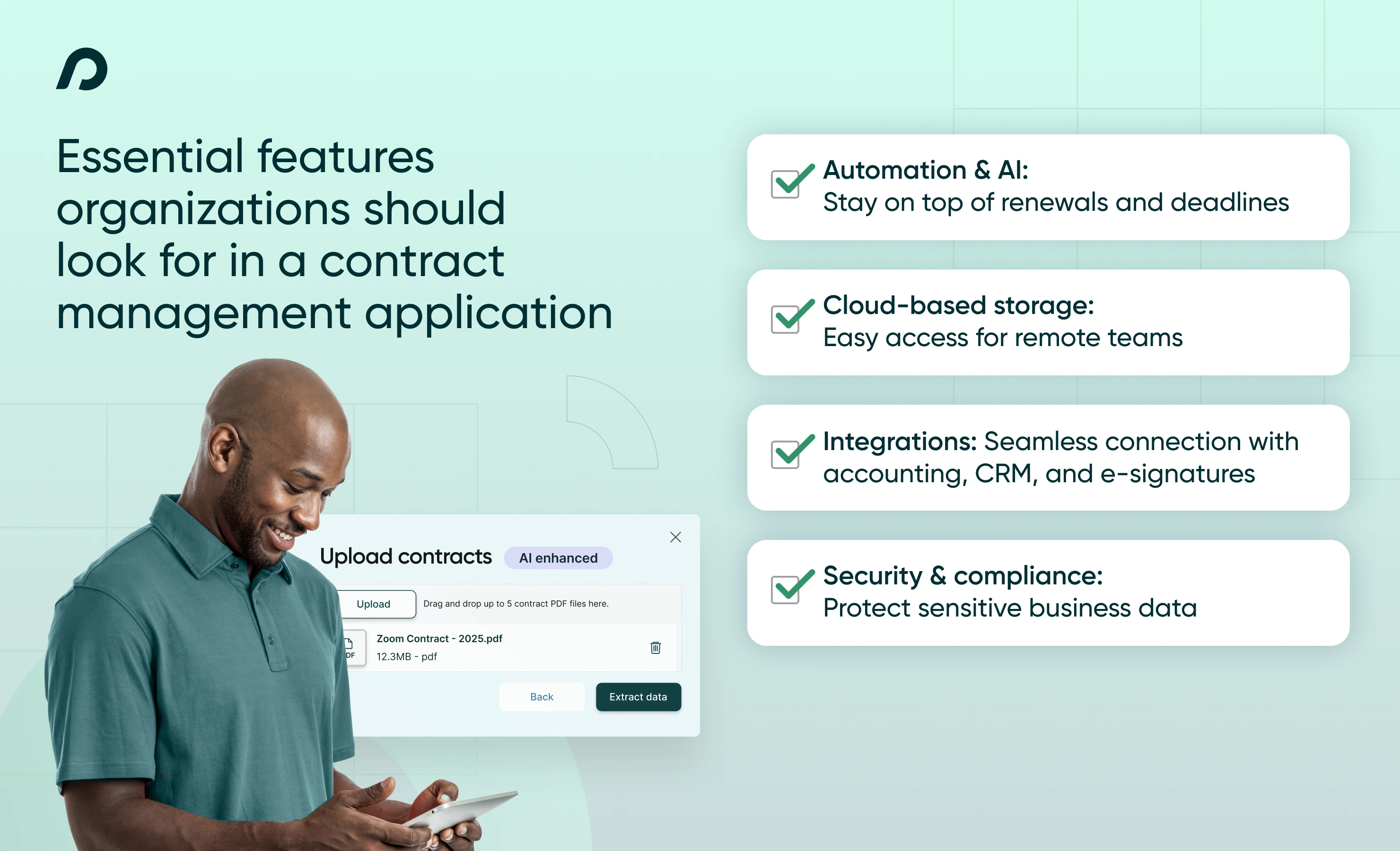
Choosing the right contract management application goes beyond simple storage—it should automate tasks, integrate seamlessly with existing systems, and provide strong security. Here are the key features to prioritize when selecting a solution
Automation & AI: Stay on top of renewals and deadlines
Manual contract tracking increases the risk of missed renewals, lost revenue, and compliance issues. A contract management application with automation and AI-powered tracking helps businesses:
-
Receive automatic alerts for upcoming renewals and deadlines to prevent costly lapses.
-
Use AI-driven analytics to identify contract risks, obligations, and opportunities.
-
Speed up approvals with procurement automation, routing contracts to the right team members.
By eliminating the need for manual tracking, automation saves hours of admin work and ensures critical deadlines are never overlooked.
Cloud-based storage: Easy access for remote teams
A cloud-based procurement system with contract management centralizes all contracts in a secure, searchable repository, making it easy to access agreements from any location.
-
No more searching through email threads or physical files—everything is stored in one place.
-
Remote access allows teams to retrieve and manage contracts from anywhere.
-
Real-time collaboration enables users to review, edit, and approve contracts online.
With hybrid and remote work becoming the norm, businesses need on-demand access to contracts without being tied to a local server or office.
Integrations: Seamless connection with accounting, CRM, and e-signatures
Contracts are directly tied to financial transactions, sales deals, and legal approvals. A strong contract management application integrates with existing tools, such as:
-
Accounting software (e.g., QuickBooks, NetSuite, Sage Intacct) to sync contract terms with financial records.
-
CRM platforms (e.g., Salesforce, HubSpot) to link sales contracts to customer accounts.
-
E-signature solutions (e.g., DocuSign, Adobe Sign) for fast, legally binding contract execution.
Integrations eliminate data silos, reduce manual entry, and improve efficiency by ensuring contract-related information flows smoothly across business systems.
Security & compliance: Protect sensitive business data
Contracts contain critical business information, making security and compliance a top priority. Look for solutions that offer:
-
Data encryption to protect contracts from unauthorized access.
-
Audit trails & version control to track every change and maintain transparency.
-
Access controls & permissions to restrict contract visibility based on user roles.
-
Regulatory compliance with industry standards like GDPR, HIPAA, or SOC 2.
Secure contract management prevents legal and financial risks, ensuring business continuity and regulatory adherence.
Key factors to consider when selecting a contract management application
Selecting a contract management application is a crucial decision that impacts efficiency, risk management, and financial control. With so many options available, businesses need to take a structured approach to find a solution that fits their needs—one that simplifies contract handling rather than adding complexity.
-
Budget and pricing transparency
Cost is always a factor, but the cheapest option isn’t necessarily the best. Beyond the monthly subscription fee, consider setup costs, training expenses, and potential hidden fees for extra users, storage, or integrations. A scalable pricing model ensures the software can grow with your business without forcing a costly switch later. Transparent pricing—without unexpected add-ons—is key to long-term value.
-
Ease of use and implementation
A contract management system should make life easier, not harder. If the platform has a steep learning curve or requires extensive onboarding, it can slow adoption and reduce efficiency. Look for software with an intuitive interface, pre-built templates, and automation features that reduce manual work. The best solutions allow teams to get up and running quickly without requiring technical expertise.
-
Automation and reminders
Contracts come with critical deadlines—renewals, payments, and obligations that can’t afford to be overlooked. A good contract management application automates renewal alerts, approval workflows, and compliance tracking, ensuring nothing slips through the cracks. AI-powered analytics can also provide insights into contract risks and performance, helping businesses make proactive decisions instead of reacting to problems.
-
Integrations with existing business tools
Contracts don’t exist in isolation—they tie into financials, sales, and legal processes. The right application should integrate smoothly with accounting software like QuickBooks or NetSuite, CRM tools like Salesforce or HubSpot, and e-signature solutions like DocuSign or Adobe Sign. Seamless integration reduces data silos and ensures that contracts are part of an efficient, connected workflow.
-
Security and compliance
Contracts often contain sensitive information, so security is non-negotiable. Strong encryption protects data from unauthorized access, while role-based access controls ensure that only the right people can view or edit specific contracts. Compliance tracking is equally important—especially for businesses operating under regulations like GDPR, SOC 2, or HIPAA. A system with built-in audit trails and compliance monitoring helps businesses stay ahead of legal and regulatory requirements.
Bonus checklist: Making the final decision
Use this checklist to ensure you’re selecting the best contract management application for your business:
-
Does the software fit within our budget without hidden costs?
-
Is the platform easy to use and quick to implement?
-
Does it provide automation for contract renewals, approvals, and tracking?
-
Can it integrate with our existing tools (ERP, CRM, e-signature solutions)?
-
Does it offer strong security features like encryption and compliance tracking?
-
Is customer support responsive and helpful?
-
Does the solution scale with our business growth?
Comparison of top contract management software
With so many contract management solutions on the market, narrowing down the right one can feel overwhelming. To help simplify the decision-making process, we’ve done the due diligence—evaluating key providers based on their features, integrations, and overall value. Below is a comparison of leading contract management applications.
Contract management software, compared
Five ways to handle contract tracking, from standalone repositories to a full
agentic procurement platform.
None of these vendors publish a static list price on their own site, so treat every dollar figure below as an estimate and confirm current terms directly with the vendor before you buy.
| Vendor | Key features | Pricing | Best for |
|---|---|---|---|
| Procurify Agentic procurement platform with contract tracking built into purchasing, budgets, approvals, and payments. |
|
Custom, quote-based Priced by product and Pro user. Basic users are free. No public list price or self-serve checkout. |
Mid-market organizations that want contract tracking connected to broader spend management rather than a standalone repository. |
| ContractSafe Searchable standalone contract repository designed for fast setup. |
|
Three tiers, by contract volume Organize, Finalize, and Maximize. Third-party sources report Organize starting around $450/month for 100 or fewer contracts. |
Teams that want a simple standalone contract repository with strong search capabilities. |
| PandaDoc Document workflow and e-signature platform focused on proposals, quotes, and contracts. |
|
Free – $49/user/month Free e-signature plan, Starter around $19/user/month, Business around $49/user/month, and custom Enterprise pricing. |
Sales teams that prioritize document creation, collaboration, and e-signature. |
| Agiloft No-code CLM platform designed for complex, high-volume contract programs. |
|
Custom, quote-based No public pricing. One third-party benchmark estimates roughly $6,000/year to $60,000+/year depending on requirements. |
Enterprises with legal or contract-operations teams managing complex CLM requirements. |
| ContractWorks Centralized contract repository with e-signature and AI-assisted search, now part of Onit. |
|
Two tiers, by document volume Standard and Premium. Third-party trackers estimate Standard pricing at roughly $600–$700/month. |
Teams that prefer unlimited-user pricing and a centralized contract repository. |
Step-by-step guide for implementing a contract management tool
Selecting a contract management application is just the first step—proper implementation ensures your organization fully adopts the tool and maximizes its benefits. Without a structured rollout, businesses risk slow adoption, inefficient workflows, and missed opportunities to streamline contract tracking. Here’s how to integrate your new system effectively and drive long-term success.
-
Identify business needs and goals
Before diving into implementation, assess what you need from a contract management tool. Consider how many contracts your business handles annually, where your biggest pain points are (missed renewals, compliance risks, tracking inefficiencies), and which teams will be responsible for managing contracts. Identifying must-have features—like automation, integrations, or security controls—ensures that the tool aligns with your organization’s needs from day one.
-
Compare tools and secure buy-in
With clear requirements in place, evaluate providers based on pricing, usability, automation capabilities, and integrations with existing tools like QuickBooks, NetSuite, or Salesforce. Shortlist a few options, request demos, and involve key stakeholders in the decision-making process. A contract management system should simplify processes, not add complexity—so choose one that fits seamlessly into your existing workflows.
-
Migrate existing contracts and standardize conventions
To make the transition smooth, start by digitizing and organizing existing contracts. Standardize naming conventions, categorize agreements (vendor contracts, NDAs, employee agreements), and assign ownership to specific team members for better accountability. Cleaning up and structuring your contract repository before migration will prevent confusion and ensure quick access to important documents.
-
Set up automated workflows
One of the biggest advantages of contract management software is automation. Configure workflows that automatically route contracts for approval, trigger renewal reminders, and maintain audit trails. If your tool integrates with spend management workflows like Procurify, align contracts with real-time budgets to ensure financial oversight. Testing these automation features with sample contracts before a full rollout will help fine-tune the process.
-
Train teams for smooth adoption
A system is only as effective as the people using it. Offer live training sessions, provide recorded tutorials, and assign contract management champions within different departments to assist their teams. Establish clear guidelines for contract storage, approvals, and tracking, and encourage feedback to refine workflows. The more intuitive the system is, the faster teams will adopt it.
-
Monitor performance and optimize over time
Once the system is in place, track its effectiveness by measuring key performance indicators like reduced missed renewals, faster contract approvals, improved compliance, and better vendor or client satisfaction. Regularly review reports, gather user feedback, and adjust workflows to maximize efficiency. A contract management tool isn’t a one-time implementation—it should continuously evolve to support business growth.
By following these steps, businesses can ensure a smooth transition and get the most value from their contract management investment. The right system doesn’t just store contracts—it enhances security, automates key processes, and provides better financial control.
So what?
Contracts are more than just paperwork—they define vendor relationships, financial commitments, and legal protections. Yet, managing them manually often leads to missed deadlines, compliance risks, and unnecessary costs. Contract management software eliminates the need for manual tracking, ensuring businesses never miss a renewal or spend hours chasing approvals. It also reduces administrative work, prevents costly auto-renewals, and optimizes vendor agreements, adding up to significant cost savings over time.
Beyond efficiency, contract management software strengthens security and compliance by protecting sensitive data, maintaining audit trails, and ensuring agreements meet regulatory requirements. Integrations with accounting, CRM, and spend management software like Procurify keep workflows efficient and eliminate data silos. And as businesses grow, a scalable contract management platform ensures long-term control, helping organizations stay ahead of their commitments without added complexity.
The longer businesses rely on spreadsheets and email threads, the more they risk contract inefficiencies costing them money and time. Investing in the right platform now means avoiding unnecessary risks and ensuring every contract works in your favor.
$30B+ in real spend data you won’t get anywhere else
Find out what it takes to move from reactive to AI-driven operations.


